


What Are Ophthalmic Viscosurgical Devices (OVDs)? A Complete Guide
Modern ophthalmic surgery has advanced significantly over the past few decades, enabling surgeons to perform increasingly complex procedures with greater precision, safety, and predictability. Among the many innovations that have transformed eye surgery, Ophthalmic Viscosurgical Devices (OVDs) have become one of the most essential tools in anterior segment surgery.
Whether performing cataract surgery, intraocular lens (IOL) implantation, corneal transplantation, or glaucoma surgery, surgeons rely on OVDs to maintain the delicate anatomy of the eye, protect sensitive tissues, and create the ideal surgical environment.
Although patients rarely hear about them, ophthalmic viscosurgical devices play a vital role in achieving successful surgical outcomes. Without them, many of today's minimally invasive ophthalmic procedures would be considerably more difficult to perform safely.
In this comprehensive guide, we'll explore:
- What Ophthalmic Viscosurgical Devices are
- How they work
- Different types of OVDs
- Common materials such as Sodium Hyaluronate and Hydroxypropyl Methylcellulose (HPMC)
- Their role in cataract surgery
- How surgeons choose the appropriate OVD
- Current innovations in ophthalmic viscoelastic technology
Whether you're an ophthalmologist, surgical trainee, hospital procurement professional, distributor, or simply interested in ophthalmic surgery, this guide provides a detailed overview of one of the most important consumables used in modern eye care.
What Are Ophthalmic Viscosurgical Devices (OVDs)?
Ophthalmic Viscosurgical Devices (OVDs) are sterile, transparent, gel-like materials specifically designed for use during ophthalmic surgery.
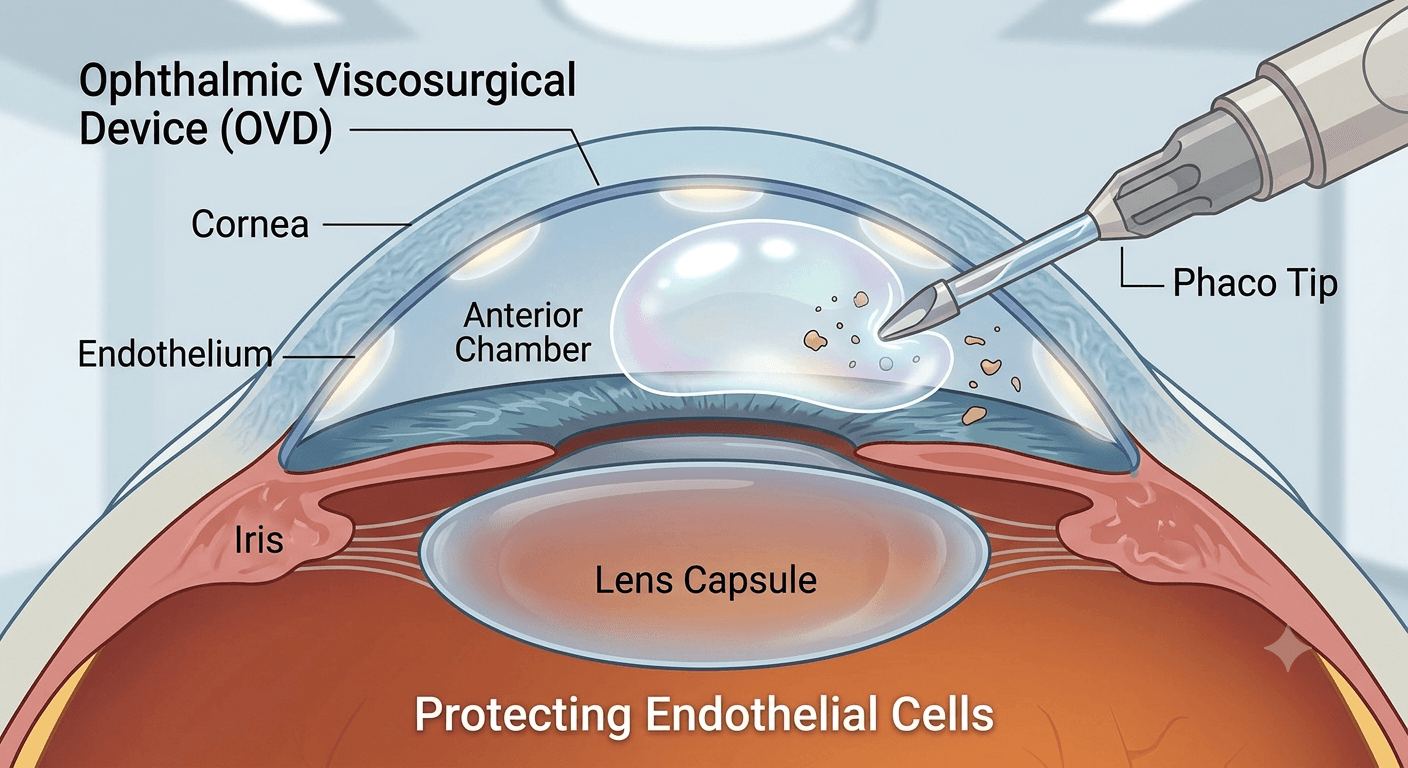
They are introduced into the anterior chamber of the eye to create and maintain space, stabilize delicate tissues, improve surgical visibility, and protect the corneal endothelium from mechanical and thermal damage.
OVDs are also commonly referred to as Ophthalmic Viscoelastic Devices. Both terms describe the same class of products and are used interchangeably throughout ophthalmology.
The word "viscosurgical" emphasizes their role during surgery, while "viscoelastic" highlights the unique physical properties that allow these materials to behave both like a liquid and an elastic substance.
These characteristics enable surgeons to manipulate ocular tissues with exceptional precision while minimizing trauma to delicate eye structures.
Today, OVDs are considered a standard component of nearly every anterior segment surgical procedure worldwide.
Why Were OVDs Developed?
Before the introduction of modern OVDs, ophthalmic surgery presented significantly greater challenges.
Surgeons often struggled to maintain the shape of the anterior chamber during procedures, making delicate intraocular manoeuvres more difficult and increasing the risk of tissue damage.
The introduction of viscoelastic materials revolutionized cataract surgery by allowing surgeons to:
- Maintain stable intraocular space
- Protect delicate corneal endothelial cells
- Improve visibility during surgery
- Reduce surgical trauma
- Facilitate safe intraocular lens implantation
- Improve overall surgical control
These innovations have contributed significantly to the excellent success rates associated with modern cataract surgery.
How Do OVDs Work?
OVDs function by temporarily occupying space inside the eye during surgery.
After being injected into the anterior chamber, they form a protective cushion around delicate tissues while maintaining the eye's natural anatomy throughout the procedure.
Unlike ordinary fluids, OVDs possess unique viscoelastic properties that allow them to:
- Flow smoothly through surgical instruments
- Maintain space inside the eye
- Absorb mechanical forces
- Coat delicate tissues
- Protect the corneal endothelium
- Stabilize the anterior chamber
- Facilitate precise surgical manipulation
At the conclusion of surgery, the OVD is carefully removed before the procedure is completed.
Why Are OVDs So Important During Eye Surgery?
The human eye contains some of the most delicate tissues in the body.
Even minor trauma can compromise visual outcomes if sensitive structures are not adequately protected during surgery.
OVDs provide several important functions that contribute to safer ophthalmic procedures.
1. Maintaining the Anterior Chamber
One of the primary functions of an OVD is maintaining the depth and stability of the anterior chamber.
A stable chamber allows surgeons to work confidently without tissues collapsing during surgery.
This improves surgical precision and reduces unnecessary manipulation of intraocular structures.
2. Protecting the Corneal Endothelium
The corneal endothelium consists of a single layer of specialized cells responsible for keeping the cornea clear.
Unlike many other cells in the human body, endothelial cells do not regenerate effectively.
· Damage to these cells may lead to:
- Corneal swelling
- Reduced vision
- Delayed recovery
- Additional surgical complications
OVDs coat the endothelial surface, providing a protective barrier against:
- Ultrasonic energy
- Surgical instruments
- Lens fragments
- Mechanical trauma
- Fluid turbulence
This protective effect is one of the most important reasons OVDs are indispensable during cataract surgery.
3. Creating Surgical Space
Modern ophthalmic surgery often requires extremely precise manipulation within a very confined area.
OVDs gently separate tissues while maintaining adequate working space.
This enables surgeons to perform delicate procedures such as:
- Capsulorhexis
- Lens removal
- Intraocular lens implantation
- Iris manipulation
- Anterior segment reconstruction
with greater control and accuracy.
4. Improving Surgical Visibility
A well-maintained anterior chamber provides better visualization throughout the procedure.
OVDs help create a clear operating environment by maintaining the normal anatomy of the eye.
Improved visibility allows surgeons to perform intricate surgical steps more efficiently and safely.
5. Facilitating Intraocular Lens (IOL) Implantation
During cataract surgery, the natural cloudy lens is removed and replaced with an artificial intraocular lens.
OVDs help create sufficient space for smooth IOL insertion while minimizing contact between the lens and delicate ocular tissues.
This contributes to accurate lens positioning and helps reduce the risk of tissue injury during implantation.
Common Procedures That Use OVDs
Although most people associate OVDs with cataract surgery, their applications extend across a wide range of ophthalmic procedures.
Common surgical applications include:
- Cataract surgery
- Phacoemulsification
- Intraocular lens implantation
- Corneal transplantation
- Glaucoma surgery
- Anterior chamber reconstruction
- Iris repair procedures
- Combined anterior segment surgeries
- Pediatric ophthalmic surgery
- Trauma reconstruction
As ophthalmic surgical techniques continue to evolve, the role of high-quality OVDs becomes increasingly important in achieving predictable clinical outcomes.
Ophthalmic Viscosurgical Devices vs Ophthalmic Viscoelastic Devices
Many healthcare professionals encounter both terms and wonder whether they describe different products.
In reality, they refer to the same category of surgical consumables.
The distinction lies primarily in terminology.
Ophthalmic Viscoelastic Device emphasizes the material's physical characteristics—its ability to behave as both a viscous fluid and an elastic substance.
Ophthalmic Viscosurgical Device emphasizes its role as a specialized surgical aid during ophthalmic procedures.
Today, both terms are widely accepted throughout ophthalmology, scientific publications, and medical device literature.
Why Product Quality Matters
Not all OVDs perform identically.
Their composition, viscosity, molecular weight, purity, sterility, and manufacturing quality all influence surgical handling characteristics.
High-quality ophthalmic viscosurgical devices provide
- Consistent chamber stability
- Reliable tissue protection
- Smooth surgical handling
- Predictable performance
- Easy injection
- Controlled removal
- Reduced surgical variability
For hospitals, eye care centers, and ophthalmic surgeons, selecting reliable ophthalmic consumables contributes to improved workflow efficiency and patient safety.
Understanding the Physical Properties of OVDs
One of the reasons Ophthalmic Viscosurgical Devices (OVDs) are so effective is their unique physical properties. Unlike ordinary saline or lubricating solutions, OVDs are specially formulated to behave as both a liquid and an elastic material.
These characteristics allow surgeons to inject the material smoothly while ensuring it remains stable inside the eye during surgery.
Understanding these properties also explains why different OVDs are preferred for different surgical situations.
Viscosity
Viscosity refers to how thick or resistant a material is to flow.
Higher-viscosity OVDs:
- Maintain the anterior chamber more effectively
- Resist deformation during surgery
- Provide excellent surgical space
- Help stabilize ocular tissues
Lower-viscosity OVDs:
- Flow more easily
- Spread quickly over tissues
- Can be easier to inject in certain situations
Finding the right balance between viscosity and handling characteristics is essential when selecting an OVD.
Elasticity
Elasticity describes the ability of the material to return to its original shape after pressure is applied.
Highly elastic OVDs:
- Resist compression
- Help maintain chamber depth
- Support delicate tissues during surgery
- Improve overall chamber stability
This property is particularly valuable during cataract surgery when maintaining a stable anterior chamber is critical.
Cohesion
Cohesion refers to how strongly the molecules of an OVD stick together.
Highly cohesive OVDs:
- Stay together as one mass
- Maintain excellent chamber stability
- Are generally easier to remove at the end of surgery
Dispersion
Dispersive OVDs spread across tissues rather than remaining together.
This allows them to:
- Coat the corneal endothelium
- Protect delicate tissues
- Cover larger surface areas
- Resist washout during surgery
These characteristics make dispersive OVDs particularly valuable when endothelial protection is the primary concern.
Pseudoplasticity
Pseudoplasticity describes a material that becomes less viscous when pressure is applied.
This means:
- Easy injection through a small cannula
- Stable performance once inside the eye
- Excellent handling during surgery
Modern ophthalmic OVDs are carefully engineered to achieve the desired balance of these physical properties.
Classification of Ophthalmic Viscosurgical Devices
OVDs are commonly classified into three major categories.
Each offers unique advantages depending on the surgical procedure and surgeon's preference.
Cohesive OVDs
Cohesive OVDs have high molecular weight and strong internal cohesion.
Rather than spreading across tissues, they remain together as a single mass.
Advantages
- Excellent chamber maintenance
- Superior space creation
- Easy injection
- Easier removal
- Stable surgical field
- Ideal for IOL implantation
Limitations
Because cohesive OVDs tend to remain together, they may provide less continuous endothelial coating than dispersive products.
Common Applications
- Routine cataract surgery
- Capsulorhexis
- Intraocular lens implantation
- Chamber maintenance
Dispersive OVDs
Dispersive OVDs behave differently.
Instead of remaining together, they spread across ocular tissues.
This creates a protective coating over delicate structures.
Advantages
- Excellent endothelial protection
- Wider tissue coverage
- Better resistance to irrigation
- Continuous protective layer
Limitations
Dispersive OVDs can sometimes require more thorough removal because they adhere more closely to tissues.
Common Applications
- Dense cataracts
- Endothelial protection
- Complex cataract surgery
- Corneal procedures
Viscoadaptive OVDs
Viscoadaptive OVDs combine characteristics of both cohesive and dispersive materials.
Their behavior changes depending on surgical conditions.
During low flow conditions they behave like cohesive OVDs.
During high flow they become more dispersive.
Advantages
- Versatile handling
- Excellent chamber stability
- Good endothelial protection
- Adaptable during surgery
Applications
- Advanced cataract surgery
- Complex anterior segment procedures
- Challenging surgical cases
Common Materials Used in OVDs
Modern ophthalmic viscosurgical devices are manufactured using carefully selected biocompatible materials.
Among these, Sodium Hyaluronate and Hydroxypropyl Methylcellulose (HPMC) are two of the most widely used.
Sodium Hyaluronate (NaHa)
Sodium Hyaluronate is a naturally occurring polysaccharide found in various tissues throughout the human body.
Its excellent viscoelastic properties make it one of the preferred materials for ophthalmic surgery.
Key Characteristics
- High molecular weight
- Excellent chamber stability
- Superior elasticity
- Outstanding tissue protection
- Smooth handling
- Easy injection
Benefits
Surgeons often prefer Sodium Hyaluronate because it:
- Maintains anterior chamber depth
- Protects the corneal endothelium
- Facilitates IOL implantation
- Improves surgical precision
- Provides consistent handling
Common Applications
- Cataract surgery
- IOL implantation
- Corneal transplantation
- Anterior segment surgery
To learn more about Sodium Hyaluronate products, explore:
Hydroxypropyl Methylcellulose (HPMC)
Hydroxypropyl Methylcellulose, commonly known as HPMC, is another widely used ophthalmic viscoelastic material.
It provides dependable lubrication and tissue protection while offering reliable performance across many ophthalmic procedures.
Advantages
- Good tissue coating
- Reliable lubrication
- Stable performance
- Cost-effective option
- Suitable for many routine surgeries
Applications
HPMC is commonly used during:
- Cataract surgery
- Lens implantation
- Anterior chamber maintenance
- General ophthalmic procedures
Learn more about HPMC products:
Sodium Hyaluronate vs HPMC
Although both materials are widely used, they offer different handling characteristics.
|
Feature |
Sodium Hyaluronate |
HPMC |
|
Chamber Maintenance |
Excellent |
Good |
|
Endothelial Protection |
Excellent |
Good |
|
Elasticity |
Higher |
Moderate |
|
Tissue Coating |
Very Good |
Good |
|
Ease of Injection |
Excellent |
Good |
|
Typical Applications |
Complex & Routine Cases |
Routine Procedures |
Neither material is universally "better."
The ideal choice depends on:
- Surgical technique
- Procedure complexity
- Surgeon preference
- Clinical objectives
For a detailed comparison, read:
Sodium Hyaluronate vs HPMC OVDs: Which One Should You Choose for Cataract Surgery?
Applications of OVDs in Modern Ophthalmology
OVDs are now considered indispensable across a wide range of ophthalmic procedures.
Cataract Surgery
Cataract surgery is the most common ophthalmic procedure worldwide.
During surgery, OVDs help:
- Maintain chamber depth
- Protect endothelial cells
- Facilitate capsulorhexis
- Support lens removal
- Simplify IOL implantation
- Improve visualization
Without appropriate OVDs, these delicate surgical steps become considerably more challenging.
Intraocular Lens (IOL) Implantation
After cataract removal, the artificial lens must be inserted carefully.
OVDs:
- Create sufficient working space
- Minimize tissue contact
- Stabilize the capsular bag
- Support accurate lens positioning
Corneal Surgery
Corneal procedures require exceptional tissue protection.
OVDs help:
- Protect endothelial cells
- Maintain tissue hydration
- Reduce mechanical trauma
- Improve surgical visibility
Glaucoma Surgery
Many glaucoma procedures require stable anterior chamber conditions.
OVDs assist by:
- Maintaining space
- Protecting adjacent tissues
- Facilitating controlled surgical manipulation
Pediatric Ophthalmic Surgery
Children's eyes require particularly delicate handling.
OVDs help surgeons perform precise intraocular procedures while minimizing tissue trauma.
How Surgeons Choose the Right OVD
Selecting an ophthalmic viscosurgical device involves multiple considerations.
No single product is ideal for every procedure.
Factors influencing OVD selection include:
Surgical Procedure
Different surgeries require different handling characteristics.
Cataract Density
Dense cataracts may require greater endothelial protection.
Chamber Stability
Some procedures prioritize maximum chamber maintenance.
Tissue Protection
Certain cases require superior coating of the corneal endothelium.
Ease of Removal
Some surgeons prefer products that are easier to remove at the conclusion of surgery.
Surgeon Experience
Personal familiarity and surgical technique often influence product selection.
Product Quality
Reliable manufacturing standards contribute to consistent surgical performance.
Hospitals and eye care centers should also consider:
- Product sterility
- Manufacturing quality
- Batch consistency
- Regulatory compliance
- Reliable supply
These factors contribute to safer surgical outcomes and improved workflow efficiency.
Choosing High-Quality Ophthalmic Consumables
While the surgeon's skill remains the most important factor in successful ophthalmic surgery, high-quality consumables also play a significant role.
Reliable ophthalmic products should offer:
- Consistent viscosity
- Excellent sterility
- Smooth handling
- Stable formulation
- Easy injection
- Predictable performance
- Dependable packaging
- Compliance with applicable regulatory standards
At Medsprings, our ophthalmic product range is designed to support modern surgical practice by providing dependable solutions for eye care professionals.
Continue Reading
To deepen your understanding of OVDs and related ophthalmic products, explore:
- How Ophthalmic Viscosurgical Devices (OVDs) Protect Delicate Eye Structures During Surgery
- Sodium Hyaluronate vs HPMC OVDs: Which One Should You Choose for Cataract Surgery?
- How Premium Ophthalmic Consumables Improve Surgical Outcomes
Latest Innovations in Ophthalmic Viscosurgical Devices
Ophthalmic surgery continues to evolve rapidly, driven by advances in microsurgical techniques, intraocular lens technology, and ophthalmic consumables. As surgical expectations increase, manufacturers continue to develop newer Ophthalmic Viscosurgical Devices (OVDs) that offer improved handling, better tissue protection, and enhanced surgical efficiency.
Today's innovations focus on delivering greater consistency while reducing surgical complexity.
Some of the latest developments include:
- Improved Sodium Hyaluronate formulations with optimized molecular weight
- Advanced viscoadaptive OVDs that combine the benefits of cohesive and dispersive products
- Enhanced syringe designs for smoother and more controlled injection
- Better manufacturing techniques for increased purity and consistency
- Improved packaging to maintain sterility and ease of use
- Formulations designed for faster and more predictable removal at the end of surgery
These advancements help ophthalmic surgeons perform increasingly precise procedures while improving efficiency and supporting positive surgical outcomes.
Common Misconceptions About OVDs
Despite being an essential part of ophthalmic surgery, there are several misconceptions surrounding Ophthalmic Viscosurgical Devices.
Myth 1: All OVDs Are the Same
This is one of the most common misconceptions.
Different OVDs vary significantly in:
- Composition
- Molecular weight
- Viscosity
- Cohesion
- Dispersion
- Surgical handling
- Clinical applications
Selecting the appropriate OVD depends on the specific surgical procedure and surgeon preference.
Myth 2: Higher Viscosity Always Means Better Performance
Although highly viscous OVDs provide excellent chamber stability, they are not automatically the best choice for every procedure.
Some surgeries benefit more from dispersive properties than high viscosity.
The "best" OVD is the one most suitable for the clinical situation.
Myth 3: OVDs Are Only Used During Cataract Surgery
While cataract surgery is the most common application, OVDs are also widely used in:
- Corneal transplantation
- Glaucoma surgery
- Pediatric ophthalmology
- Iris reconstruction
- Anterior segment procedures
- Trauma surgery
Myth 4: Choosing an OVD Is Only About Cost
Although cost is an important consideration for hospitals and healthcare providers, product quality, consistency, sterility, and surgical performance are equally important.
High-quality ophthalmic consumables contribute to smoother surgical workflows and reliable performance.
How Hospitals and Eye Care Centers Should Choose OVD Suppliers
Selecting an ophthalmic consumables supplier involves much more than comparing prices.
Healthcare providers should consider several important factors.
Product Quality
Reliable manufacturing processes ensure:
- Consistent viscosity
- Stable formulations
- Predictable handling
- Batch-to-batch consistency
Sterility
Every ophthalmic consumable should be manufactured and packaged under strict sterile conditions.
Maintaining sterility is essential for patient safety.
Regulatory Compliance
Healthcare providers should select products manufactured in accordance with applicable quality standards and regulatory requirements.
Depending on the market, this may include compliance with ISO standards, CE marking, or other relevant regulatory frameworks.
Reliable Supply Chain
Consistent product availability is critical.
Reliable suppliers help minimize disruptions to surgical schedules and ensure hospitals can maintain uninterrupted patient care.
Technical Support
Good suppliers provide:
- Product documentation
- Technical information
- Training materials
- Responsive customer support
This helps healthcare professionals make informed purchasing decisions.
Why High-Quality Ophthalmic Consumables Matter
Every ophthalmic procedure involves delicate tissues and microscopic precision.
While surgical skill remains the most important factor in successful outcomes, dependable consumables contribute significantly to:
- Consistent chamber stability
- Smooth surgical handling
- Reliable product performance
- Efficient surgical workflow
- Protection of delicate ocular tissues
Using well-manufactured ophthalmic products allows surgeons to focus on the procedure itself rather than dealing with inconsistent material behavior.
Why Choose Medsprings?
At Medsprings, we understand that ophthalmic surgery demands precision, reliability, and consistency.
Our goal is to support ophthalmologists, hospitals, eye care centers, and distributors by providing high-quality ophthalmic surgical consumables designed for modern surgical practice.
Our ophthalmic product portfolio includes carefully selected solutions developed to meet the needs of a wide range of anterior segment procedures.
Why healthcare professionals choose Medsprings:
- High-quality ophthalmic consumables
- Reliable product performance
- Carefully selected product portfolio
- Products designed for modern ophthalmic surgery
- Consistent quality standards
- Dedicated customer support
- Commitment to innovation in eye care
We continue to expand our product range while supporting healthcare professionals with educational resources and product information that help improve clinical decision-making.
Related Products
Explore Medsprings' range of Ophthalmic Viscosurgical Devices and learn more about individual product categories.
Ophthalmic Viscosurgical Devices (OVDs)
Sodium Hyaluronate (NaHa)
Hydroxypropyl Methylcellulose (HPMC)
Related Articles
Continue learning about ophthalmic surgery and surgical consumables with these related resources.
- How Ophthalmic Viscosurgical Devices (OVDs) Protect Delicate Eye Structures During Surgery
- Sodium Hyaluronate vs HPMC OVDs: Which One Should You Choose for Cataract Surgery?
- How High-Quality Ophthalmic Consumables Improve Surgical Outcomes
These articles provide deeper insights into OVD selection, surgical techniques, and the role of premium ophthalmic consumables in modern eye surgery.
Frequently Asked Questions
What is an Ophthalmic Viscosurgical Device (OVD)?
An Ophthalmic Viscosurgical Device is a sterile viscoelastic material used during ophthalmic surgery to maintain the anterior chamber, protect delicate eye tissues, improve visualization, and facilitate surgical procedures.
Are Ophthalmic Viscosurgical Devices and Ophthalmic Viscoelastic Devices the same?
Yes. The terms "Ophthalmic Viscosurgical Device (OVD)" and "Ophthalmic Viscoelastic Device" are commonly used interchangeably within ophthalmology.
Why are OVDs used during cataract surgery?
OVDs help maintain chamber depth, protect the corneal endothelium, stabilize ocular tissues, improve visibility, and assist with intraocular lens implantation.
What is the difference between cohesive and dispersive OVDs?
Cohesive OVDs primarily maintain chamber stability and are generally easier to remove, while dispersive OVDs spread across tissues and provide excellent endothelial protection.
Which is better: Sodium Hyaluronate or HPMC?
Neither is universally better. The choice depends on the surgical procedure, surgeon preference, handling characteristics, and clinical objectives.
Can OVDs reduce endothelial cell damage?
OVDs are designed to provide a protective barrier for the corneal endothelium during surgery, helping to minimize mechanical and thermal stress.
Are OVDs removed after surgery?
Yes. At the conclusion of most procedures, surgeons carefully remove the OVD before completing surgery.
Which ophthalmic procedures commonly use OVDs?
OVDs are commonly used during:
- Cataract surgery
- Intraocular lens implantation
- Glaucoma surgery
- Corneal transplantation
- Anterior segment reconstruction
- Pediatric ophthalmic surgery
How should OVDs be stored?
Storage requirements vary by manufacturer. Healthcare providers should always follow the product's official instructions for use regarding storage and handling.
Why is product quality important?
Consistent product quality supports reliable handling characteristics, predictable surgical performance, and efficient workflow within the operating room.
Are all OVD formulations identical?
No. OVDs differ in their composition, viscosity, cohesion, dispersion, molecular weight, and intended clinical applications.
How do surgeons choose an OVD?
Selection depends on several factors, including:
- Surgical technique
- Case complexity
- Desired chamber stability
- Endothelial protection
- Surgeon preference
- Product handling characteristics
Final Thoughts
Ophthalmic Viscosurgical Devices have become one of the most important innovations in modern ophthalmic surgery. From maintaining anterior chamber stability to protecting delicate corneal tissues and facilitating precise intraocular lens implantation, OVDs contribute significantly to the safety and efficiency of today's surgical procedures.
Understanding the different types of OVDs, their physical properties, and the characteristics of materials such as Sodium Hyaluronate and Hydroxypropyl Methylcellulose (HPMC) enables surgeons and healthcare providers to make informed product selections based on the needs of each procedure.
As ophthalmic surgery continues to evolve, high-quality surgical consumables remain an essential component of successful clinical practice.
At Medsprings, we are committed to supporting ophthalmic professionals through reliable products, educational resources, and a growing portfolio of ophthalmic solutions designed for modern eye care.
Whether you're exploring OVDs for the first time or looking to compare different formulations, we invite you to explore our product range and educational content to help support informed clinical decisions.