


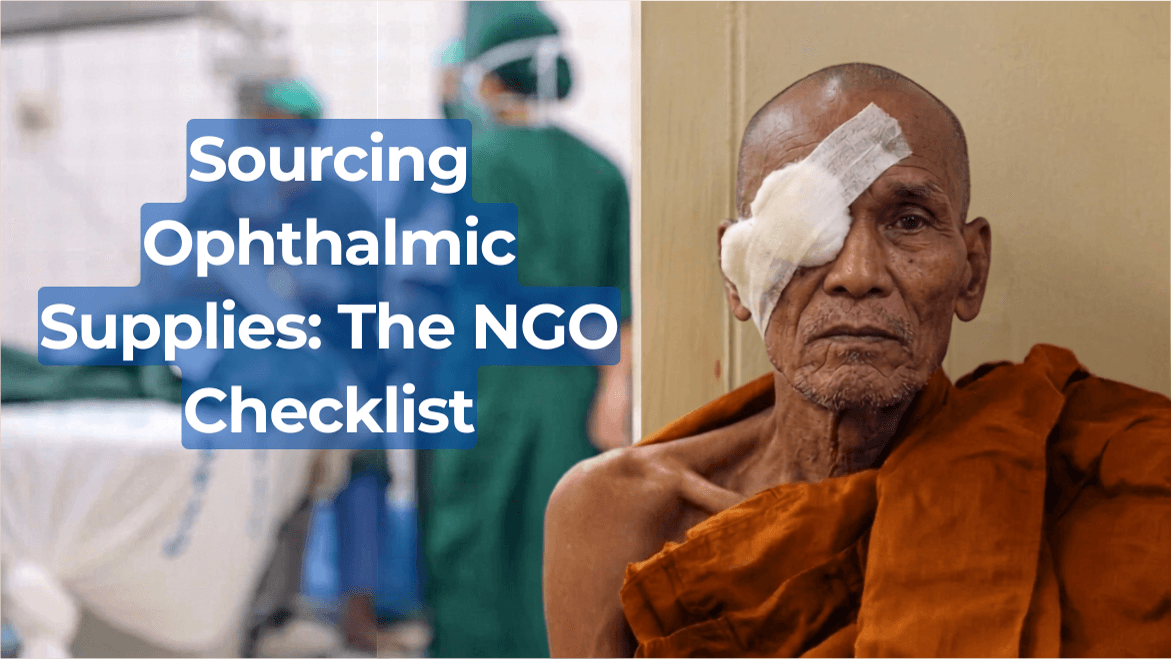
Every minute, an avoidable case of blindness goes untreated—not just for a lack of surgical skill, but also for a lack of available, high-quality medical supplies.
When managing global eye care missions, a single delayed shipment, compromised sterile barrier, or unexpected customs rejection doesn't just impact a budget—it directly halts surgical schedules and leaves vulnerable communities waiting.
Sourcing directly from Indian medical device suppliers has become one of the most effective strategies for scaling surgical yields while maximizing every dollar of funding. However, with lower costs comes the ultimate responsibility: ensuring that uncompromised quality, strict international compliance, and supply chain integrity remain intact every step of the way.
To safeguard your surgical outcomes, stretch program budgets, and eliminate procurement bottlenecks, use this essential compliance checklist when evaluating manufacturing and supply partners in India.
1. Value for Money: Maximizing Impact Per Dollar
For non-profit organizations, every dollar saved directly translates to another patient regaining their sight. True value for money isn't about buying cheap—it’s about uncompromised quality at a sustainable cost structure.
- Optimized Cost-Per-Surgery: Partner with suppliers who offer direct factory pricing, allowing your organization to stretch mission budgets further without sacrificing clinical outcomes.
- Transparent Pricing Models: Ensure your supplier provides clear, upfront pricing with no hidden handling fees, customs surcharges, or administrative markups.
- High-Quality Standards at Scale: Verify that cost savings are achieved through manufacturing efficiency and scale—not by cutting corners on raw materials or regulatory compliance.
2. One-Stop Solutions: Streamlining Vendor Management
Managing dozens of individual vendors for lenses, viscoelastics, sutures, and surgical blades creates administrative chaos and increases shipping risks. A single-source supplier radically simplifies program operations.
- Complete Product Portfolio: Look for partners capable of supplying all core ophthalmic verticals—from intraocular lenses (PMMA, Hydrophilic, Hydrophobic) to OVDs, surgical sutures, micro-blades, equipment, and diagnostic tools.
- Unified Quality & Compliance Audit: Sourcing from a one-stop supplier means auditing one trusted vendor, consolidating documentation, and managing a single vendor relationship.
- Consolidated Shipping & Bulk Freight Savings: Bundling all project consumables into consolidated shipments lowers total freight costs and simplifies import processing at destination ports.
3. Customization Capabilities: Mission-Ready Surgical Kits
No two surgical missions are identical. Whether running high-volume cataract camps or specialized glaucoma clinics, customized kit packaging saves valuable time in the field.
- Tailored Procedure Kits: Partner with suppliers who offer fully customized kit assembly—such as dedicated Cataract Kits, Glaucoma Kits, or Refractive Kits—pre-packed with exact clinician-preferred specifications (IOLs, sutures, blades, viscoelastics, and drapes).
- Field-Ready Assembly: Pre-sterilized, single-pack procedure kits eliminate preparation delay in high-throughput camp environments, allowing surgical teams to perform more procedures safely and efficiently.
- Private Labeling & Custom Branding: Confirm if the supplier provides custom kit branding, neutral coding, or tailored labeling matching your NGO’s project specifications.
4. Core Quality Management Systems (QMS)
A supplier’s commitment to quality starts at the facility level. Before diving into individual product specifications, verify that your potential partner operates within universally recognized quality management frameworks.
- ISO 13485:2016 Certification: Confirm the manufacturing facility holds ISO 13485 specifically audited for medical device design, manufacturing, packaging, and sterility assurance.
- WHO-GMP Compliance: Request proof of Good Manufacturing Practice (GMP) certification issued by competent regulatory authorities, confirming cleanroom standards (typically ISO Class 5 to 7 environments) for sterile intraocular products.
5. Regulatory Approvals & Certifications
Navigating regulatory requirements is critical to avoiding customs seizures and guaranteeing patient safety across target deployment regions. Partner with suppliers that possess a complete, verified portfolio of national and international regulatory credentials.
- CE Marking (MDR/MDD): Ensure surgical consumables carry valid CE Certification under current European Medical Device Regulations, confirming compliance with strict health and safety standards for high-risk medical devices.
- National Medical Device & Manufacturing Licenses: Confirm that the manufacturer holds all requisite statutory licenses, drug control authorizations, and product registration certificates issued by national health authorities to produce and distribute medical devices legally.
- Free Sale Certificates (FSC): Require official Free Sale Certificates issued by competent regulatory bodies, validating that the products are approved for open market distribution in the manufacturing country and cleared for export worldwide.
- Fully Compliant Product Dossiers: Verify that the vendor maintains complete technical files and regulatory dossiers ready for swift submission to regional health authorities in your deployment destinations.
6. Packaging, Sterility & Cold Chain Integrity
Deploying supplies into rugged, low-resource settings demands packaging that can handle harsh transit conditions without compromising product sterility.
- Sterilization Validation: Ask for lot-specific batch sterilization reports (EtO or Gamma radiation) backed by physical biological indicator test logs.
- Tropicalized Packaging: Ensure primary packaging (blister packs and sterile pouches) complies with ISO 11607 standards, passing accelerated aging tests for high heat and humidity.
- Cold Chain Assurance: For temperature-sensitive liquids or gels, verify that the supplier uses calibrated data loggers and insulated, cold-chain-compliant shipping containers built for remote transit.
7. End-to-End Logistics, Customs Clearance & Cost Management
Navigating international borders—especially into developing or remote regions—can be the biggest failure point for medical supply chains. Your supplier must offer integrated, transparent logistics solutions.
- Cost-Effective Freight Quotes: Look for partners who leverage established volume relationships with global carriers to provide competitive freight rates (Air/Sea) without hidden administrative fees, stretching your program budget further.
- Smooth Import/Export Customs Clearance: Partner with suppliers who collaborate with specialized medical freight forwarders capable of handling export documentation out of India and managing pre-cleared, hassle-free customs entry in the destination country.
- Customs Documentation & Duty Pre-Clearance: Ensure the supplier provides pre-vetted import permits, correct HS code classifications, and local regulatory documentation to prevent shipments from getting held at port entry.
- Real-Time GPS & Milestone Tracking: Demand end-to-end cargo visibility. Your logistics network should provide milestone updates and real-time tracking from warehouse dispatch to final field delivery.
- Proactive Status Communication: Ensure there is active communication regarding flight schedules, customs status, and estimated delivery dates so campaign logistics teams on the ground can prepare accordingly.
8. Responsive Customer Service & Post-Sale Reliability
Seamless execution during a high-volume surgical campaign requires human coordination, proactive communication, and rapid problem-solving.
- Dedicated NGO Project Managers: Look for suppliers who assign a single point-of-contact for your project—someone who understands campaign timelines, batch matching, and multi-destination dispatch schedules.
- Batch Consistency & Replenishment Guarantee: Verify that the supplier maintains lot traceability so you can easily reorder identical diopters, suture sizes, or consumables with exact specification matches for follow-up missions.
- Post-Market Support & Replacement Policy: A transparent supplier offers straightforward, hassle-free replacement policies for any transit-damaged goods or compromised packaging upon delivery.
Aligning Values: Why Choosing the Right Partner Matters
At its core, global eye care procurement is not just about transactions—it’s about shared mission, vision, and trust. Organizations that succeed in restoring vision at scale rely on manufacturing and export partners who share their core morals and ethical values.
Partners like Medsprings are built on this exact philosophy: viewing healthcare supply not merely as a commercial venture, but as a commitment to patient-centric impact and uncompromising quality. By offering value-driven pricing, complete custom procedure kits (Cataract, Glaucoma, and more), and a true one-stop sourcing model, Medsprings serves as a seamless extension of non-profit procurement teams.
When your supply chain partner shares your dedication to eliminating avoidable blindness, every campaign runs smoother, every budget goes further, and thousands more patients regain their sight.