


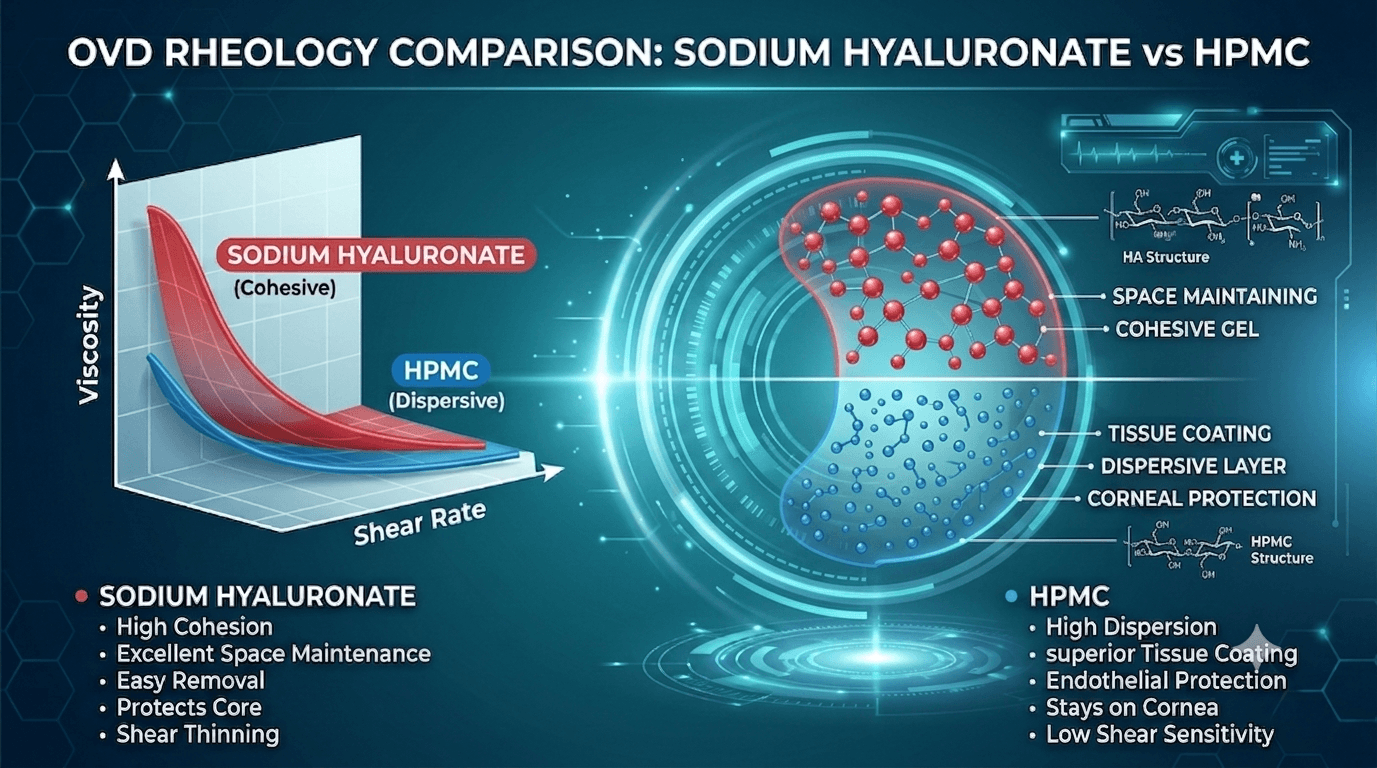
Sodium Hyaluronate vs HPMC OVDs: Which One Should You Choose for Cataract Surgery?
Modern cataract surgery relies on precision, visibility, and tissue protection. Among the most critical surgical aids used during phacoemulsification are Ophthalmic Viscosurgical Devices (OVDs), which help maintain the anterior chamber, protect delicate ocular tissues, and facilitate safe intraocular lens (IOL) implantation.
Two of the most commonly used OVD materials are Sodium Hyaluronate (NaHA) and Hydroxypropyl Methylcellulose (HPMC). While both are widely used by ophthalmic surgeons, each possesses unique rheological properties that make it suitable for different surgical situations.
In this guide, we'll explore the differences between Sodium Hyaluronate and HPMC OVDs to help surgeons, procurement teams, and eye care professionals understand when each option may be most appropriate.
What Is an Ophthalmic Viscosurgical Device (OVD)?
An Ophthalmic Viscosurgical Device (OVD) is a sterile, transparent viscoelastic solution used during ophthalmic procedures, particularly cataract surgery.
OVDs play several important roles:
-
Maintain the depth and stability of the anterior chamber
-
Protect the corneal endothelium
-
Improve surgical visualization
-
Create space for intraocular lens implantation
-
Reduce trauma to delicate intraocular tissues
Today, OVDs are considered an essential component of cataract surgery and are also used in glaucoma, corneal, vitreoretinal, and other anterior segment procedures.
Understanding Sodium Hyaluronate OVDs
Sodium Hyaluronate is a naturally occurring polysaccharide found within the human eye. Because of its excellent viscoelastic properties, it has become one of the most widely used materials for ophthalmic surgery.
Key Benefits
-
Excellent chamber maintenance
-
Superior optical clarity
-
High elasticity
-
Effective tissue separation
-
Smooth intraocular lens implantation
-
Excellent protection of ocular structures
Its cohesive nature also allows surgeons to remove the material efficiently at the end of surgery while maintaining excellent surgical control. Sodium hyaluronate-based OVDs have long been regarded as a benchmark in anterior segment surgery.
Explore Medsprings Sodium Hyaluronate OVDs
Understanding HPMC OVDs
Hydroxypropyl Methylcellulose (HPMC) is another widely used ophthalmic viscoelastic that offers dependable tissue protection and chamber maintenance.
Because of its dispersive characteristics, HPMC spreads well across ocular tissues, providing consistent endothelial coating throughout surgery.
Key Benefits
-
Excellent endothelial protection
-
Reliable chamber maintenance
-
Good tissue coating
-
Cost-effective solution
-
Easy handling during routine cataract surgery
-
Suitable for a wide range of ophthalmic procedures
Clinical studies have shown that HPMC performs comparably to Sodium Hyaluronate in many routine cataract procedures while remaining an effective and economical option.
Explore Medsprings HPMC OVDs
Sodium Hyaluronate vs HPMC: Side-by-Side Comparison
| Feature | Sodium Hyaluronate | HPMC |
|---|---|---|
| Chamber Stability | Excellent | Very Good |
| Endothelial Protection | Excellent | Excellent |
| Optical Clarity | Excellent | Excellent |
| Tissue Coating | Good | Excellent |
| Ease of Removal | Easier (cohesive) | Moderate (more dispersive) |
| Routine Cataract Surgery | Excellent | Excellent |
| Complex Surgical Cases | Frequently Preferred | Commonly Used |
Both OVDs are widely accepted in ophthalmic practice. The ideal choice depends on surgical technique, case complexity, and surgeon preference rather than a single universally superior product. Comparative studies have shown broadly similar surgical outcomes in many routine phacoemulsification cases.
Which OVD Should You Choose?
Choose Sodium Hyaluronate when:
-
Maintaining chamber depth is a priority.
-
Excellent surgical visibility is required.
-
Smooth IOL implantation is essential.
-
Higher-viscosity cohesive behavior is preferred.
Choose HPMC when:
-
Strong endothelial coating is desired.
-
Routine cataract surgery is being performed.
-
A dependable and economical OVD is preferred.
-
Consistent tissue protection is required.
Ultimately, the "best" OVD depends on the surgeon's technique, the patient's ocular condition, and the demands of the specific procedure.
Why Quality OVDs Matter
Selecting a high-quality ophthalmic viscosurgical device can contribute to:
-
Improved surgical efficiency
-
Better intraoperative visibility
-
Enhanced protection of intraocular tissues
-
Reduced surgical manipulation
-
Consistent surgical performance
Reliable OVDs support surgeons in achieving predictable outcomes while protecting delicate ocular structures throughout the procedure.
Medsprings Ophthalmic Viscosurgical Devices
Medsprings offers a range of ophthalmic viscosurgical devices designed to support modern cataract and anterior segment surgery.
Whether your practice prefers Sodium Hyaluronate or HPMC, our products are developed to provide dependable performance, tissue protection, and ease of handling.
Explore our product range:
Sodium Hyaluronate (NaHA)
Sodium Hyaluranate
HPMC OVDs
HPMC
Frequently Asked Questions
What is the main purpose of an Ophthalmic Viscosurgical Device?
OVDs help maintain the anterior chamber, protect the corneal endothelium, improve visualization, and facilitate safe intraocular procedures.
Is Sodium Hyaluronate better than HPMC?
Neither material is universally better. Sodium Hyaluronate is often favored for its cohesive properties and ease of removal, while HPMC is valued for its dispersive coating characteristics and cost-effectiveness. The choice depends on the clinical situation and surgeon preference.
Can both OVDs be used in cataract surgery?
Yes. Both Sodium Hyaluronate and HPMC are widely used during phacoemulsification and intraocular lens implantation worldwide.
How do OVDs protect the cornea?
OVDs form a protective layer over the corneal endothelium, helping reduce mechanical trauma from surgical instruments and ultrasound energy during cataract surgery.
Conclusion
Choosing between Sodium Hyaluronate and HPMC is not about selecting a universally superior product—it's about choosing the OVD whose properties best match the surgical technique and clinical requirements.
Both materials have demonstrated excellent performance in cataract surgery and remain trusted solutions for ophthalmic surgeons worldwide. By understanding their individual strengths, eye care professionals can make informed decisions that support surgical precision, patient safety, and optimal clinical outcomes.
At Medsprings, we are committed to providing high-quality ophthalmic viscosurgical devices that help surgeons perform with confidence while delivering the highest standard of patient care.