


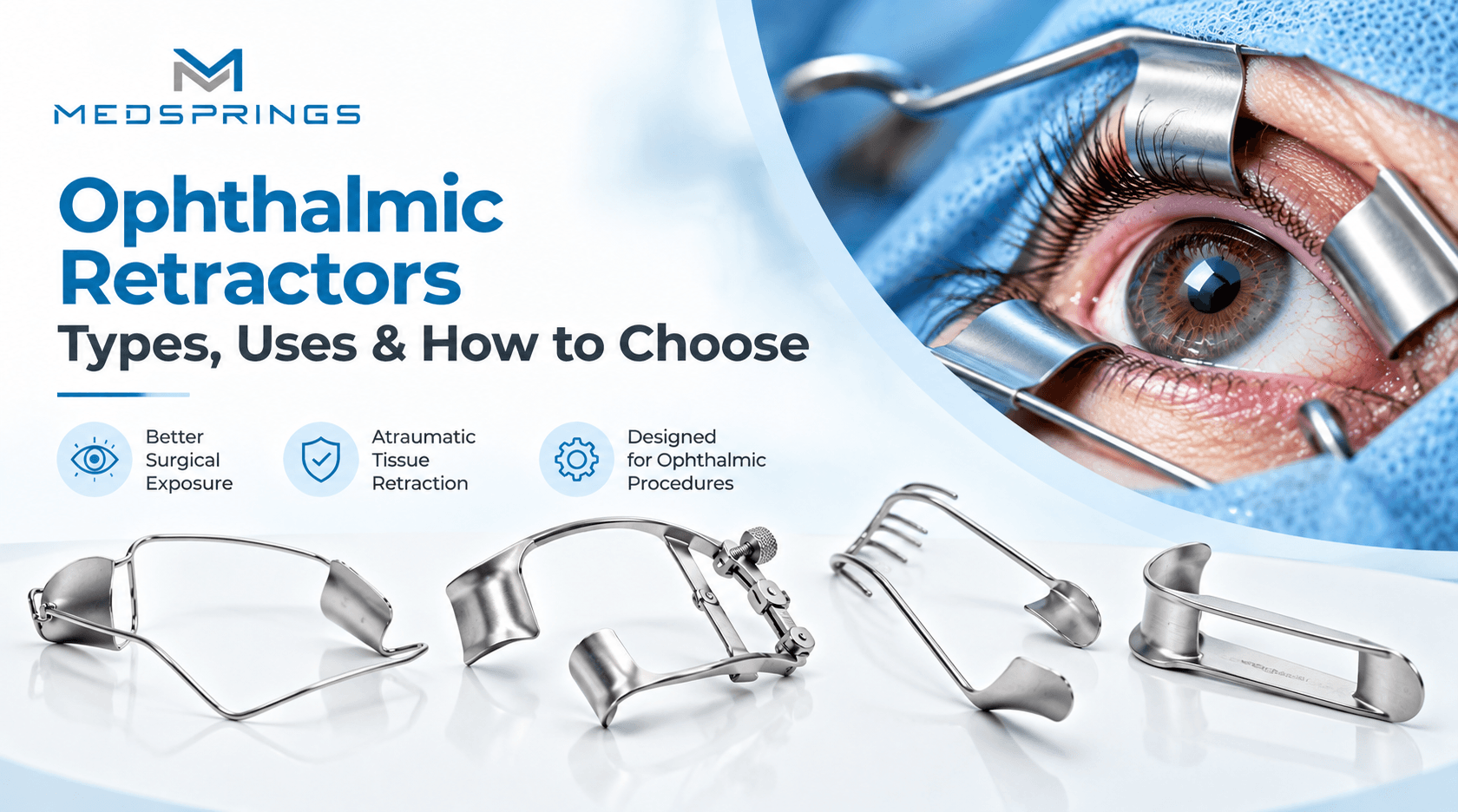
Ophthalmic Retractors: Types, Uses & How to Choose
Ophthalmic retractors are specialized surgical instruments used to gently hold, separate, or retract tissue and structures around the eye during ophthalmic and oculoplastic procedures.
Unlike general surgical retractors, ophthalmic retractors are designed for the confined anatomy and precision requirements of eye surgery. Different designs may be intended for eyelid, orbital, lacrimal, muscle, or soft-tissue retraction.
For hospitals, ophthalmology clinics, surgical centres, medical distributors, importers, and healthcare procurement teams, selecting the right ophthalmic retractor requires consideration of the surgical application, blade or prong design, working depth, tissue characteristics, instrument handling, material, sterilization requirements, and supplier capabilities.
Medsprings offers a range of ophthalmic surgical instruments, including specialized retractors for different ophthalmic and oculoplastic applications.
What Is an Ophthalmic Retractor?
An ophthalmic retractor is a surgical instrument designed to hold tissue away from the operative area, providing the surgeon with better access and visibility.
Depending on the design, a retractor may be used to:
-
Retract eyelid tissue
-
Hold soft tissue away from the surgical field
-
Provide orbital exposure
-
Retract tissue during lacrimal procedures
-
Assist with muscle exposure
-
Support access during oculoplastic procedures
-
Maintain exposure during specialized ophthalmic surgery
The design of the retractor depends heavily on the type of tissue being retracted and the depth and location of the surgical field.
This is why an ophthalmic retractor used for delicate pediatric eye surgery may have very different characteristics from one designed for deeper orbital exposure.
Why Are Ophthalmic Retractors Important?
Ophthalmic procedures often involve small anatomical structures and restricted working spaces.
A suitable retractor can help provide:
Better Surgical Exposure
Retracting surrounding tissue can create a clearer working area for the surgeon.
Controlled Tissue Positioning
Different blade and prong configurations allow surgeons to manage tissue according to the procedure.
Improved Instrument Access
Adequate exposure can make it easier to introduce other ophthalmic surgical instruments into the operative field.
Consistent Retraction
A properly designed instrument can maintain tissue position while the surgeon concentrates on the primary surgical task.
Procedure-Specific Access
Different retractors can be selected according to the anatomy and surgical approach involved.
For procurement teams, this means that a hospital may require several retractor designs rather than relying on one universal instrument.
Types of Ophthalmic Retractors
Ophthalmic retractors can be broadly differentiated by their blade configuration, number of ends, tissue engagement, and intended surgical application.
Common designs include:
-
Double-ended retractors
-
Solid-blade retractors
-
Pronged retractors
-
Orbital retractors
-
Eyelid retractors
-
Muscle retractors
-
Specialized pediatric retractors
The right choice depends on the surgical procedure and the tissue that needs to be exposed.
Senn Miller Retractor
The Senn Miller Retractor is a double-ended surgical retractor designed for versatile tissue exposure.
One end incorporates an L-shaped solid blade, while the opposite end features a three-pronged rake.
This gives the instrument two different retraction configurations within a single instrument.
Applications of the Senn Miller Retractor
The Senn Miller Retractor can be used in:
-
Oculoplastic procedures
-
Lacrimal surgery
-
Dacryocystorhinostomy procedures
-
Orbitotomy
-
Eyelid reconstruction
-
Orbital and facial procedures
-
Minor ophthalmic surgery
The dual-ended design can be particularly useful in procedures where the surgeon needs to alternate between broader surface retraction and more localized tissue engagement.
For hospitals and surgical centres, a dual-function instrument can also help reduce the number of separate instruments required for particular procedures.
Helveston Barbie Retractor
The Helveston Barbie Retractor is designed for delicate tissue and muscle retraction in ophthalmic surgery.
Medsprings positions this instrument particularly for strabismus and pediatric eye surgery, where controlled and delicate tissue handling can be important.
Its specialized design makes it different from a general-purpose surgical retractor.
For ophthalmology departments that perform pediatric or strabismus procedures, having procedure-specific retractors available can help surgeons select instruments according to the requirements of the surgical field.
Schepens Orbital Retractor
The Schepens Orbital Retractor is designed for deeper tissue retraction and orbital exposure.
Medsprings lists applications including:
-
Scleral buckling procedures
-
Vitreoretinal surgery
-
Strabismus surgery
-
Orbital procedures
Its design is intended to provide controlled exposure while maintaining a smooth, atraumatic interaction with surrounding tissue.
For ophthalmic surgical centres with vitreoretinal, orbital, or strabismus services, specialized orbital retractors can form an important part of the surgical instrument inventory.
Universal Reversible Lid Retractor
A lid retractor serves a different purpose from deeper orbital or tissue retractors.
The Universal Reversible Lid Retractor is designed for eyelid eversion and retraction during diagnostic and surgical procedures.
Its reversible configuration allows the instrument to be used for different eyelid-retraction requirements.
This type of instrument can be particularly relevant for ophthalmology departments that need a versatile solution for routine examination and surgical applications.
Ophthalmic Retractors vs Eye Speculums
Ophthalmic retractors and eye speculums are related but serve different purposes.
An eye speculum is primarily used to maintain separation of the eyelids and keep the surgical field open.
An ophthalmic retractor is generally used to retract specific tissues or structures to provide access to a particular surgical area.
For example:
| Instrument | Primary function |
|---|---|
| Eye Speculum | Maintains eyelid separation |
| Lid Retractor | Retracts or everts eyelid tissue |
| Tissue Retractor | Holds soft tissue away from the operative field |
| Orbital Retractor | Provides deeper orbital exposure |
| Muscle Retractor | Provides access around extraocular muscles |
Hospitals may therefore require both speculums and retractors within their ophthalmic surgical instrument inventory.
If you are also sourcing eyelid exposure instruments, Medsprings offers products such as the Williams Eye Speculum and Clark Eye Speculum.
How to Choose the Right Ophthalmic Retractor
Selecting an ophthalmic retractor should begin with the intended surgical application.
1. Identify the Procedure
The first question should be:
What procedure will the instrument be used for?
Different procedures may require different retraction characteristics.
Consider whether the instrument will be used for:
-
Strabismus surgery
-
Pediatric ophthalmic surgery
-
Lacrimal surgery
-
Oculoplastic surgery
-
Eyelid reconstruction
-
Orbital surgery
-
Vitreoretinal procedures
-
Scleral buckling
-
General ophthalmic procedures
Procedure-specific selection is usually more useful than selecting an instrument based only on its general category.
2. Consider the Tissue Being Retracted
Different tissues require different approaches.
For delicate tissues, a retractor may require a smoother or more atraumatic configuration.
For denser tissue, a pronged design may provide the required grip.
This is why instruments such as the Senn Miller Retractor offer different ends for different tissue-retraction requirements.
3. Evaluate Blade or Prong Configuration
Retractors can feature:
-
Solid blades
-
Rounded blades
-
Sharp prongs
-
Blunt prongs
-
Multiple-prong configurations
-
Curved blades
The configuration should correspond to the surgical application.
For example, a specialized orbital retractor may require a different blade profile from a small eyelid retractor.
4. Consider Working Depth
The required depth of the surgical field is another important factor.
A superficial eyelid procedure may require a relatively compact instrument.
Orbital or vitreoretinal procedures may require an instrument capable of reaching deeper anatomical structures while maintaining adequate control.
5. Evaluate Instrument Handling
The instrument should provide the surgeon with sufficient control during tissue retraction.
Consider:
-
Handle shape
-
Instrument balance
-
Grip
-
Weight
-
Blade positioning
-
Visibility
-
Ease of manipulation
These characteristics become especially important during procedures requiring prolonged or precise retraction.
6. Check Material and Surface Finish
Ophthalmic instruments should be evaluated for:
-
Material quality
-
Corrosion resistance
-
Surface finish
-
Structural integrity
-
Tip or blade consistency
-
Sterilization compatibility
Medsprings lists surgical-grade stainless steel or titanium construction across its current retractor portfolio, with low-glare satin finishes and smooth blade contours on applicable products.
7. Consider Sterilization Requirements
For reusable ophthalmic instruments, procurement teams should confirm compatibility with the hospital's sterilization workflow.
Important considerations include:
-
Cleaning process
-
Sterilization method
-
Autoclave compatibility
-
Corrosion resistance
-
Repeated-use durability
-
Storage requirements
The manufacturer's product documentation should always be followed for the specific instrument.
Choosing Retractors for a Hospital Ophthalmology Department
For hospital procurement teams, purchasing individual instruments without considering the broader surgical workflow can result in an incomplete instrument inventory.
A more practical approach is to map retractors to the procedures performed by the department.
For example:
Cataract and Anterior Segment
May require:
-
Eye speculums
-
Ophthalmic knives
-
Forceps
-
Cannulas
-
Choppers
-
Nucleus manipulators
Explore the Ophthalmic Knives range and Surgical Instruments & Consumables portfolio.
Strabismus Surgery
May require:
-
Specialized retractors
-
Muscle forceps
-
Scissors
-
Needle holders
-
Muscle-specific instruments
A Helveston Barbie Retractor can be considered where a specialized retractor is required for strabismus and pediatric ophthalmic procedures.
Oculoplastic and Lacrimal Surgery
May require:
-
Tissue retractors
-
Eyelid retractors
-
Forceps
-
Scissors
-
Needle holders
The Senn Miller Retractor is designed for applications including oculoplastic and lacrimal procedures.
Vitreoretinal and Orbital Procedures
May require:
-
Orbital retractors
-
Specialized forceps
-
Scissors
-
Other vitreoretinal instruments
The Schepens Orbital Retractor is designed for applications including scleral buckling and vitreoretinal surgery.
Ophthalmic Retractors for Medical Distributors
For medical distributors, product selection should extend beyond individual instrument specifications.
A commercially useful ophthalmic instrument portfolio should consider:
-
Product breadth
-
Procedure coverage
-
Consistent product specifications
-
Packaging
-
Documentation
-
Availability
-
Order quantities
-
Export support
-
Supplier communication
-
Long-term supply capability
A distributor serving ophthalmology clinics may need several different retractor designs rather than a single generic product.
Working with a specialized ophthalmic supplier can make it easier to build a portfolio around actual clinical applications.
Medsprings' current portfolio includes retractors, eye speculums, forceps, scissors, needle holders, choppers, nucleus manipulators, ophthalmic knives, OVDs, and diagnostic products.
Sourcing Ophthalmic Retractors from India
For international buyers, product selection is only one part of the procurement decision.
Hospitals and distributors sourcing from an Indian ophthalmic company may also need to evaluate:
-
Manufacturing capability
-
Product documentation
-
Quality systems
-
Export experience
-
Packaging
-
Logistics support
-
Product registration requirements
-
OEM/private-label capability
-
Long-term supply capacity
The company also provides dedicated international market information for healthcare buyers.
Supplying Ophthalmic Retractors to South Africa
South Africa is one of the international markets specifically covered by Medsprings.
The Medsprings South Africa ophthalmic surgical products page provides information for hospitals, clinics, distributors, and healthcare procurement organizations across cities including Johannesburg, Cape Town, Pretoria, Durban, Port Elizabeth, Bloemfontein, East London, and Polokwane.
The country's dedicated product portfolio includes retractors such as:
-
Senn Miller Retractor
-
Helveston Barbie Retractor
-
Schepens Orbital Retractor
-
Universal Reversible Lid Retractor
alongside eye speculums, forceps, scissors, ophthalmic knives, OVDs, and other ophthalmic products.
For South African distributors or hospital procurement teams, this provides an opportunity to source multiple ophthalmic instrument categories from a specialized supplier rather than managing separate suppliers for every product type.
Supplying Ophthalmic Retractors to Egypt
Medsprings also maintains a dedicated Egypt ophthalmic products page for hospitals, ophthalmology clinics, distributors, and medical importers.
The Egypt portfolio includes ophthalmic retractors alongside surgical instruments, ophthalmic knives, OVDs, diagnostic equipment, and other ophthalmic products.
For importers and distributors, the ability to source multiple complementary products can be particularly useful when developing or expanding an ophthalmic product portfolio.
Why Buy Ophthalmic Retractors from a Specialized Supplier?
When purchasing ophthalmic surgical instruments, a supplier's specialization can be an important procurement consideration.
A specialized ophthalmic supplier can potentially support a broader range of procedure-specific requirements within the same product portfolio.
Medsprings' ophthalmic portfolio includes:
-
Ophthalmic retractors
-
Eye speculums
-
Forceps
-
Scissors
-
Needle holders
-
Choppers
-
Nucleus manipulators
-
Ophthalmic knives
-
OVDs
-
Diagnostic equipment
-
Ophthalmic consumables
This allows hospitals and distributors to evaluate complementary products through a single ophthalmic-focused supplier.
You can explore the complete Medsprings product catalogue to review the wider range.
What Should Procurement Teams Ask Before Ordering?
Before placing a bulk or institutional order for ophthalmic retractors, procurement teams should confirm:
1. What procedure is the instrument intended for?
Make sure the design corresponds to the actual surgical application.
2. What material is used?
Confirm the material and surface finish specified for the instrument.
3. Is the instrument reusable?
Confirm the manufacturer's cleaning, sterilization, and reuse instructions.
4. Are multiple configurations available?
A supplier with multiple designs can make portfolio standardization easier.
5. What documentation is available?
Ask about technical specifications, product documentation, quality information, and regulatory documents applicable to the market.
6. Can the supplier support bulk orders?
This is particularly important for hospitals, distributors, and institutional procurement.
7. Can the supplier support international export requirements?
Importers should clarify packaging, documentation, logistics, and product registration support before placing an order.
Related Products
If you are sourcing ophthalmic retractors for a hospital, clinic, surgical centre, or distribution portfolio, two relevant Medsprings products to consider are:
Senn Miller Retractor
A double-ended retractor combining an L-shaped solid blade and three-pronged rake for applications including oculoplastic, lacrimal, orbital, and minor ophthalmic procedures.
Helveston Barbie Retractor
A specialized retractor designed for delicate tissue and muscle retraction, particularly for strabismus and pediatric eye surgery.
For broader procurement requirements, explore the Surgical Instruments & Consumables category.
Frequently Asked Questions About Ophthalmic Retractors
What is an ophthalmic retractor?
An ophthalmic retractor is a surgical instrument used to hold or retract tissue and structures around the eye, providing surgeons with improved access and visibility during ophthalmic procedures.
What are ophthalmic retractors used for?
Depending on their design, ophthalmic retractors can be used for oculoplastic, lacrimal, orbital, strabismus, pediatric, vitreoretinal, scleral buckling, and other ophthalmic procedures.
What is the difference between an ophthalmic retractor and an eye speculum?
An eye speculum primarily maintains eyelid separation, while an ophthalmic retractor is generally designed to retract specific tissues or structures to provide access to a particular surgical area.
What is a Senn Miller Retractor used for?
The Senn Miller Retractor is a double-ended instrument used for applications including oculoplastic surgery, lacrimal procedures, orbitotomy, eyelid reconstruction, and other minor ophthalmic procedures.
What is a Helveston Barbie Retractor used for?
The Helveston Barbie Retractor is designed for delicate tissue and muscle retraction, particularly in strabismus and pediatric eye surgery.
What is a Schepens Orbital Retractor used for?
The Schepens Orbital Retractor is designed for orbital and deeper tissue exposure, with applications including scleral buckling, vitreoretinal, and strabismus procedures.
How should hospitals choose an ophthalmic retractor?
Hospitals should consider the procedure, tissue involved, required working depth, blade or prong configuration, instrument handling, material, sterilization requirements, and supplier support.
Can medical distributors source ophthalmic retractors from Medsprings?
Medsprings supports medical distributors, importers, hospitals, clinics, and healthcare procurement organizations looking for ophthalmic surgical products and international supply solutions.
Explore Ophthalmic Retractors from Medsprings
Choosing the right ophthalmic retractor starts with the surgical application.
A retractor designed for pediatric strabismus surgery may have very different requirements from an instrument used for orbital exposure or lacrimal surgery. For this reason, hospitals and distributors should evaluate retractors based on procedure, tissue type, working depth, instrument design, and long-term procurement requirements.
Medsprings provides a growing range of ophthalmic surgical instruments, including retractors, eye speculums, forceps, scissors, needle holders, choppers, ophthalmic knives, and OVDs.
If you are a hospital, ophthalmology clinic, medical distributor, importer, or healthcare procurement organization, you can explore the Medsprings product catalogue or contact Medsprings with your specific instrument requirements.
For bulk orders, distributor partnerships, international supply, OEM/private-label requirements, or institutional procurement, share your product list and required quantities with the Medsprings team for a tailored enquiry.