


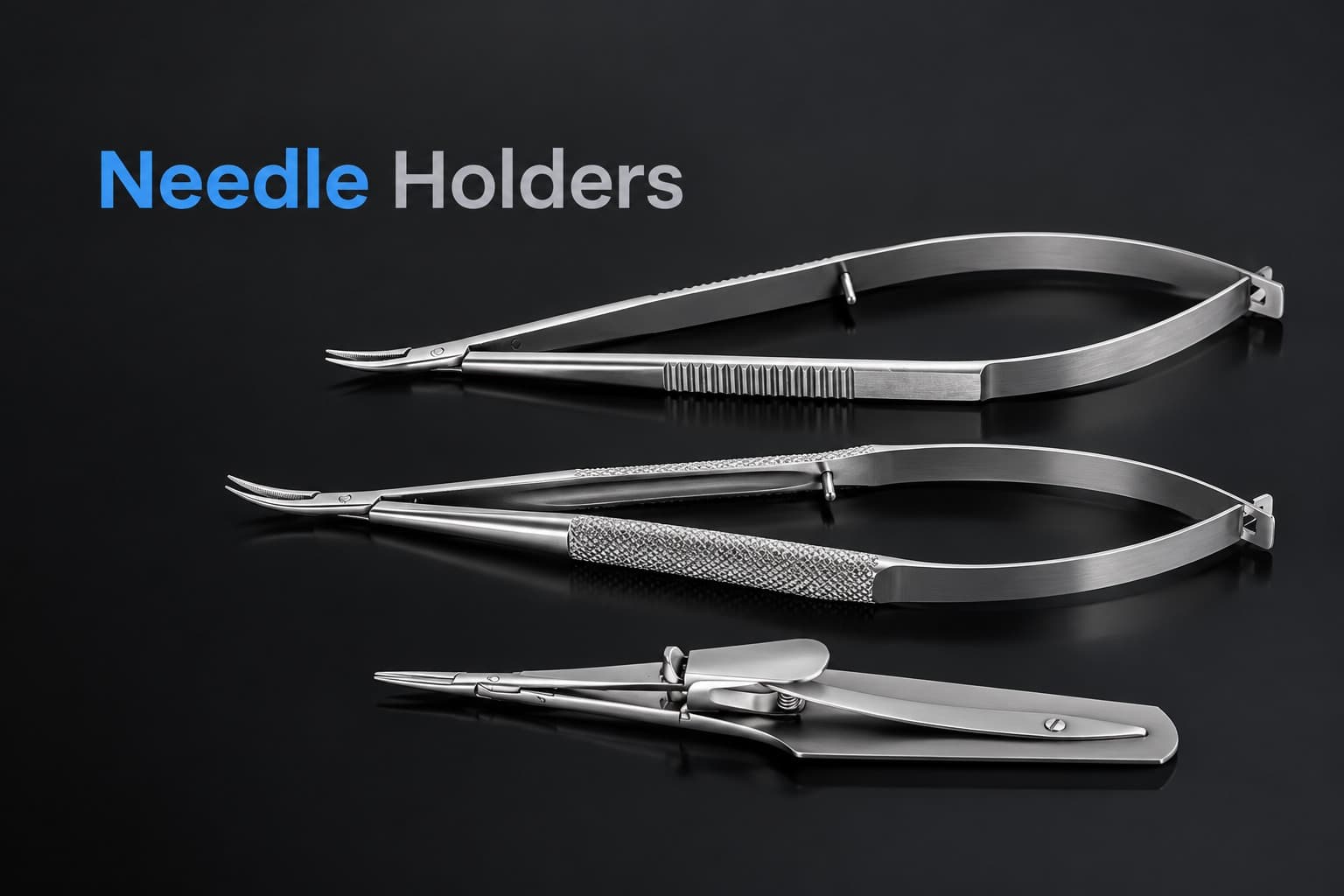
Ophthalmic Needle Holders: Types, Uses & How to Choose
Ophthalmic needle holders are precision surgical instruments designed to securely grip and manipulate suture needles during eye surgery. Because ophthalmic procedures often involve delicate tissues, fine sutures, and restricted surgical access, needle holders are available in different jaw designs, shaft configurations, handle mechanisms, and sizes.
The appropriate needle holder depends on the procedure, suture size, needle characteristics, surgical access, and surgeon preference.
For hospitals, ophthalmology clinics, surgical centres, medical distributors, importers, and healthcare procurement teams, selecting the right ophthalmic needle holder is therefore an important part of building a reliable ophthalmic instrument portfolio.
Medsprings provides a range of ophthalmic surgical instruments and needle holders for healthcare organizations and international medical distributors.
What Is an Ophthalmic Needle Holder?
An ophthalmic needle holder is a surgical instrument used to grasp, control, and position a suture needle during ophthalmic procedures.
Unlike general-purpose needle holders, ophthalmic designs are developed for the precision and limited working space associated with eye surgery.
Depending on the design, ophthalmic needle holders can be used for:
-
Corneal suturing
-
Cataract-related suturing
-
Scleral suturing
-
Conjunctival procedures
-
Oculoplastic surgery
-
Extraocular muscle procedures
-
Fine microsurgical suturing
-
Anterior-segment procedures
-
Posterior-segment procedures
The design of the instrument affects how securely the needle is held and how easily the surgeon can position it.
Why Are Ophthalmic Needle Holders Important?
Ophthalmic suturing often requires precise needle control.
A suitable needle holder can provide:
Secure Needle Grip
The jaws need to hold the needle firmly while minimizing unwanted rotation or movement.
Precise Needle Positioning
Fine jaw configurations allow the surgeon to position the needle accurately within a restricted surgical field.
Controlled Suturing
The handle and jaw mechanism influence how smoothly the surgeon can manipulate the needle.
Access to Difficult Anatomical Areas
Curved shafts and specialized jaw configurations can provide access to areas that may be difficult to reach with a straight instrument.
Reduced Instrument Movement
A properly selected needle holder helps maintain control while passing the needle through delicate ocular tissues.
For hospitals and surgical centres, this makes needle-holder selection an important part of ophthalmic instrument procurement.
Types of Ophthalmic Needle Holders
Ophthalmic needle holders are not all designed for the same application.
Common types include:
-
Castroviejo needle holders
-
Mayo needle holders
-
McPherson needle holders
-
Corneal needle holders
-
Barraquer needle holders
-
Arruga needle holders
-
Superior rectus needle holders
Each design can provide different characteristics in terms of needle size, grip, access, handle mechanism, and surgical application.
Castroviejo Needle Holder
The Castroviejo needle holder is widely associated with precision microsuturing.
Medsprings' Castroviejo Needle Holder is designed for fine suturing applications and is available with different jaw and configuration options.
According to its current product specifications, the instrument is designed for fine suture needles in the 8-0 to 11-0 range, with straight or curved jaw configurations and smooth, serrated, or tungsten-carbide jaw options.
This type of needle holder can be particularly relevant when precise needle control is required for delicate ocular tissues.
Key considerations
When selecting a Castroviejo-style needle holder, consider:
-
Suture size
-
Jaw configuration
-
Straight versus curved profile
-
Smooth versus serrated jaws
-
Tungsten-carbide options
-
Spring action
-
Catch-lock requirements
-
Surgeon preference
For microsurgical applications, tip alignment and tactile control are especially important.
Mayo Needle Holder
The Mayo needle holder is designed for applications requiring a stronger grip than the fine microsurgical profile of a Castroviejo-type instrument.
Medsprings' Mayo Needle Holder is designed for applications including oculoplastic and extraocular tissue suturing.
Its current specifications describe straight and curved configurations, cross-hatched serrated jaws or tungsten-carbide inserts, and suitability for medium-to-heavy needles in the 4-0 to 7-0 range.
This makes it a different procurement requirement from a fine microsurgical needle holder.
Key considerations
When evaluating a Mayo needle holder, procurement teams can consider:
-
Needle size range
-
Straight or curved pattern
-
Jaw material
-
Ratchet mechanism
-
Grip strength
-
Handle ergonomics
-
Sterilization requirements
Corneal Needle Holders
Corneal needle holders are designed for suturing applications involving the cornea and other delicate anterior-segment structures.
Because corneal procedures may require fine sutures and controlled needle placement, the instrument should provide:
-
Accurate jaw alignment
-
Secure needle grip
-
Fine tip control
-
Appropriate working length
-
Smooth operation
When sourcing corneal needle holders, hospitals should match the instrument to the procedures performed by their ophthalmic department.
Barraquer Needle Holders
Barraquer needle holders are another specialized option used in ophthalmic microsurgery.
Their design can provide controlled needle manipulation within a relatively restricted surgical field.
When evaluating this type of instrument, consider the required suture size, handle design, jaw configuration, and intended procedure.
McPherson Needle Holders
McPherson needle holders are commonly associated with ophthalmic microsurgical applications where controlled needle manipulation is required.
Their compact design can be useful when access and precision are important considerations.
For procurement teams, the relevant specifications should include:
-
Jaw configuration
-
Instrument length
-
Handle mechanism
-
Suture compatibility
-
Material
-
Sterilization requirements
Superior Rectus Needle Holders
Some ophthalmic procedures require specialized access around the superior portion of the globe.
The Superior Rectus Needle Holder from Medsprings uses an angled and curved shaft intended to improve access around the upper globe and brow region. Its current specifications describe use with 4-0 to 6-0 bridle suture needles.
This illustrates why needle holders should be selected according to the specific anatomical and procedural requirement rather than treated as interchangeable instruments.
Castroviejo vs Mayo Needle Holder
The difference between these two designs illustrates an important procurement principle: needle holder selection should be based on the suturing application and needle size.
| Feature | Castroviejo | Mayo |
|---|---|---|
| Typical application | Fine microsuturing | Higher-tension suturing |
| Example suture range | 8-0 to 11-0 | 4-0 to 7-0 |
| Handle style | Spring-action / optional catch-lock | Finger-ring ratchet |
| Jaw options | Smooth, serrated, TC | Serrated, TC |
| Profile | Fine precision | Heavy-duty grip |
| Example procedures | Corneal, cataract, scleral | Oculoplastic, extraocular |
The exact instrument should still be selected according to the surgical technique and manufacturer's specifications.
How to Choose the Right Ophthalmic Needle Holder
1. Start With the Procedure
Identify the procedure before selecting the instrument.
Possible applications include:
-
Corneal surgery
-
Cataract surgery
-
Scleral procedures
-
Oculoplastic surgery
-
Extraocular muscle procedures
-
Conjunctival surgery
-
Microsurgical suturing
Different procedures can require different needle-holder configurations.
2. Match the Instrument to the Suture Size
Suture size is one of the most important selection factors.
Fine ophthalmic sutures may require a delicate microsurgical needle holder, while larger sutures used for extraocular or oculoplastic procedures may require a stronger jaw configuration.
For example, Medsprings specifies its Castroviejo Needle Holder for 8-0 to 11-0 needles, while its Mayo Needle Holder is specified for 4-0 to 7-0 needles.
3. Consider Jaw Design
Jaw surfaces can be smooth, serrated, or manufactured with tungsten-carbide inserts.
The choice affects:
-
Needle grip
-
Needle stability
-
Rotation resistance
-
Handling
-
Instrument durability
Fine microsurgical applications may require a different jaw configuration from higher-tension suturing.
4. Choose Straight or Curved Jaws
Straight jaws can provide direct access and predictable needle positioning.
Curved configurations can help when the surgical approach requires access around anatomical structures or from a particular angle.
The choice should reflect the surgical approach rather than simply instrument availability.
5. Evaluate the Handle Mechanism
Different needle holders use different handle mechanisms.
Common configurations include:
-
Spring-action handles
-
Ring handles
-
Catch-lock mechanisms
-
Ratchet mechanisms
The preferred mechanism depends on the procedure and surgeon's technique.
6. Consider Instrument Balance
The instrument should provide controlled movement without unnecessary hand fatigue.
Procurement teams should evaluate:
-
Weight
-
Handle ergonomics
-
Spring tension
-
Jaw movement
-
Balance
-
Tactile response
These factors can become particularly important when the instrument is used repeatedly during microsurgical procedures.
7. Evaluate Material and Finish
Ophthalmic needle holders should be evaluated for:
-
Surgical-grade material
-
Corrosion resistance
-
Jaw durability
-
Surface finish
-
Tip alignment
-
Sterilization compatibility
Medsprings lists surgical stainless steel and, for selected needle-holder configurations, lightweight titanium as available materials. Its product specifications also describe satin or anti-reflective finishes for selected instruments.
Ophthalmic Needle Holders for Different Surgical Departments
Hospitals may require multiple needle-holder configurations because ophthalmology encompasses several different surgical specialties.
Cataract and Anterior-Segment Surgery
Potential requirements include:
-
Fine needle holders
-
Castroviejo-type needle holders
-
Corneal needle holders
-
Fine forceps
-
Ophthalmic scissors
-
Ophthalmic knives
-
Cannulas
Medsprings also supplies Hydrodissection Cannulas and other cataract surgery instruments.
Corneal Surgery
Corneal procedures may require fine needle control and specialized instruments for delicate tissue handling.
Procurement teams may consider:
-
Corneal needle holders
-
Fine forceps
-
Corneal scissors
-
Ophthalmic knives
-
Speculums
Oculoplastic Surgery
Oculoplastic procedures can require stronger needle-holding capability depending on the tissue and suture size.
A heavier-duty design such as the Mayo Needle Holder may be relevant for selected applications.
Extraocular Muscle Procedures
Specialized instruments may be required for procedures involving extraocular muscles.
The Superior Rectus Needle Holder is an example of a design developed around a particular anatomical access requirement.
Ophthalmic Needle Holders and Other Surgical Instruments
Needle holders are normally used as part of a larger ophthalmic surgical instrument set.
Depending on the procedure, procurement teams may also require:
-
Forceps
-
Scissors
-
Retractors
-
Eye speculums
-
Choppers
-
Nucleus manipulators
-
Cannulas
-
Ophthalmic knives
-
Surgical trays and sterilization equipment
Medsprings' Surgical Instruments & Consumables category provides access to a broader range of ophthalmic surgical instruments.
The Reusable Surgical Instruments section specifically includes needle holders as a dedicated product group.
What Medical Distributors Should Consider
For medical distributors and importers, selecting ophthalmic needle holders involves more than choosing individual instruments.
A supplier should ideally support a broader ophthalmic portfolio.
Product Range
A supplier with multiple needle-holder designs can help distributors serve different surgical applications.
Consistent Specifications
Repeated orders require consistency in dimensions, jaw alignment, materials, and performance.
Complementary Products
Distributors may want to source needle holders alongside:
-
Forceps
-
Scissors
-
Retractors
-
Speculums
-
Ophthalmic knives
-
Cannulas
-
Choppers
-
OVDs
This allows the distributor to develop a broader ophthalmic portfolio rather than selling individual instruments in isolation.
Documentation
International buyers should confirm the technical and regulatory documentation required for their market.
Packaging and Export Support
Precision instruments require appropriate packaging and international shipping arrangements.
Medsprings states that it supports distributors and importers with areas including import documentation, regulatory support, product registration assistance, and international supply.
Sourcing Ophthalmic Needle Holders from India
When sourcing ophthalmic instruments internationally, the country of origin is only one part of supplier evaluation.
Hospitals, distributors, and importers should assess:
-
Product range
-
Manufacturing capability
-
Product consistency
-
Technical specifications
-
Quality systems
-
Documentation
-
Export experience
-
Packaging
-
Lead times
-
Bulk-order capability
-
OEM/private-label options
Medsprings focuses on ophthalmic products and supplies surgical instruments alongside ophthalmic knives, OVDs, diagnostic equipment, and other ophthalmic solutions.
For international buyers, this broader portfolio can simplify sourcing across multiple ophthalmic categories.
Ophthalmic Needle Holder Supply for South Africa
Medsprings supports ophthalmic product supply for South African hospitals, clinics, distributors, and healthcare procurement organizations through its dedicated South Africa ophthalmic products page.
The market page includes needle holders alongside other surgical instruments, ophthalmic knives, OVDs, diagnostic equipment, and ophthalmic accessories.
For South African distributors, this creates an opportunity to source multiple ophthalmic instrument categories through a specialized supplier rather than managing every product category independently.
Ophthalmic Needle Holder Supply for Egypt
Medsprings also maintains a dedicated Egypt ophthalmic products page for hospitals, clinics, distributors, and medical importers.
The current Egypt portfolio includes multiple needle-holder configurations, including Castroviejo, Mayo, McPherson, Corneal, Arruga, Barraquer, and Superior Rectus needle holders.
This type of product breadth can be useful for distributors building a more complete ophthalmic surgical instrument portfolio.
Procurement Checklist for Ophthalmic Needle Holders
Before placing an order, procurement teams should confirm:
-
Intended surgical application
-
Required suture size
-
Needle type
-
Straight or curved configuration
-
Jaw design
-
Jaw material
-
Handle mechanism
-
Instrument length
-
Material
-
Surface finish
-
Sterilization method
-
Reuse requirements
-
Quantity required
-
Packaging requirements
-
Technical documentation
-
Lead time
-
Export documentation
For distributors, it is also useful to request information about bulk pricing, repeat-order availability, OEM/private-label options, and complementary ophthalmic products.
Related Products
Castroviejo Needle Holder
A precision needle holder designed for fine microsuturing, with configurations intended for 8-0 to 11-0 suture needles.
Mayo Needle Holder
A heavier-duty needle holder designed for applications requiring stronger needle grip, with configurations specified for 4-0 to 7-0 needles.
Frequently Asked Questions
What is an ophthalmic needle holder used for?
An ophthalmic needle holder is used to securely grip and manipulate suture needles during eye surgery.
What is the difference between a Castroviejo and Mayo needle holder?
Castroviejo needle holders are designed for fine microsuturing and Medsprings specifies them for 8-0 to 11-0 needles. Mayo needle holders provide a heavier-duty grip and are specified by Medsprings for 4-0 to 7-0 needles.
Which needle holder is used for corneal surgery?
Fine ophthalmic needle holders such as Castroviejo-style or dedicated corneal needle holders may be used depending on the procedure, suture, and surgeon's technique.
What factors should I consider when buying ophthalmic needle holders?
Consider the surgical application, suture size, jaw design, straight or curved configuration, handle mechanism, material, tip alignment, sterilization requirements, and surgeon preference.
Are ophthalmic needle holders reusable?
Many ophthalmic needle holders are designed as reusable surgical instruments. However, cleaning, sterilization, and reuse requirements depend on the specific product and manufacturer's instructions.
Can hospitals purchase ophthalmic needle holders in bulk?
Yes. Hospitals and healthcare procurement organizations can discuss bulk requirements, product configurations, quantities, and supply arrangements directly with an ophthalmic instrument supplier.
Can distributors import ophthalmic needle holders from Medsprings?
Medsprings supports medical distributors, importers, hospitals, and healthcare procurement organizations with ophthalmic products and international supply support.
Explore Ophthalmic Needle Holders from Medsprings
The right ophthalmic needle holder depends on the suture, surgical procedure, anatomical access, and required level of needle control.
For hospitals and surgical centres, selecting procedure-specific needle holders can help build a more appropriate ophthalmic instrument set. For distributors and importers, access to multiple needle-holder configurations can help support a wider range of ophthalmic customers.
Medsprings provides ophthalmic needle holders alongside forceps, scissors, retractors, eye speculums, choppers, cannulas, ophthalmic knives, OVDs, and other ophthalmic products.
Explore Medsprings' complete product catalogue or contact the Medsprings team with your required instrument types, specifications, and quantities for international supply enquiries.