


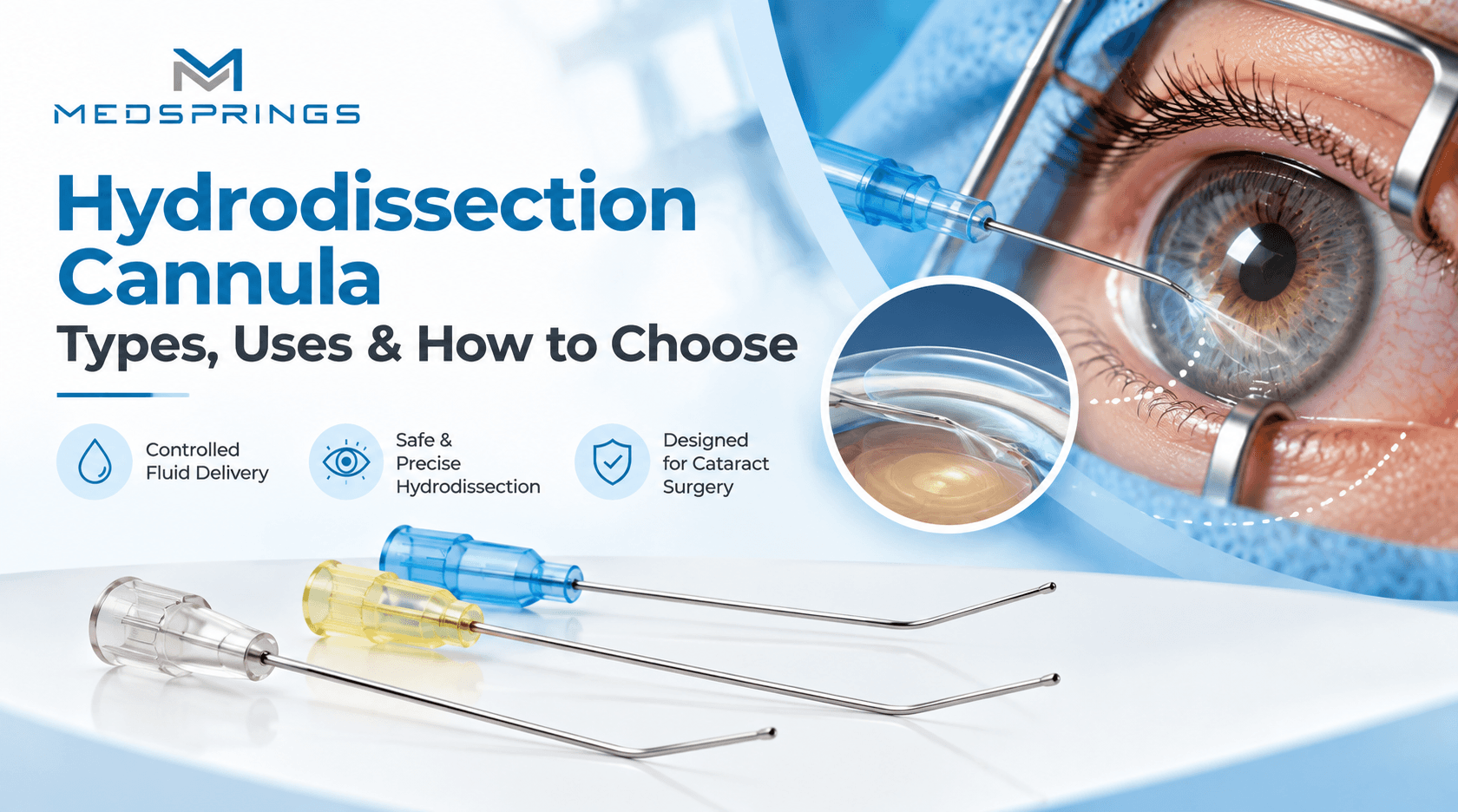
Hydrodissection Cannula: Types, Uses & How to Choose
A hydrodissection cannula is an ophthalmic surgical instrument used to deliver controlled fluid beneath the anterior capsule during cataract surgery. By directing fluid between the lens capsule and cortex, the cannula helps separate the cortical material from the capsule and facilitates subsequent lens manipulation.
The design of the cannula can influence how easily it can be positioned, how fluid is delivered, and how effectively the surgeon can perform hydrodissection.
For hospitals, ophthalmology clinics, surgical centres, medical distributors, and healthcare procurement teams, selecting a hydrodissection cannula involves considering factors such as tip configuration, gauge size, shaft design, fluid control, material, sterilization requirements, and intended procedure.
Medsprings offers hydrodissection cannulas in multiple configurations for ophthalmic surgical applications.
What Is a Hydrodissection Cannula?
A hydrodissection cannula is a fine ophthalmic cannula designed to introduce fluid between the lens capsule and cortical material.
During cataract surgery, controlled fluid injection can help create separation between the lens and surrounding capsule. This separation can make subsequent lens rotation and manipulation easier during the procedure.
A hydrodissection cannula typically consists of:
-
A narrow cannula shaft
-
A specialized distal tip
-
A hub for syringe attachment
-
A lumen for controlled fluid delivery
The exact design varies according to the intended application.
Medsprings' Hydrodissection Cannula is designed for delicate anterior-segment procedures and features multiple gauge and tip configurations.
What Is Hydrodissection Used For in Cataract Surgery?
Hydrodissection is commonly associated with cataract surgery and is performed to help separate the lens cortex from the capsule.
The technique can assist with:
-
Cortical-capsular separation
-
Lens mobilization
-
Lens rotation
-
Subsequent nucleus manipulation
-
More controlled removal of lens material
The cannula is positioned beneath the anterior capsule edge and fluid is introduced in a controlled manner.
The design of the cannula tip is therefore important because the instrument needs to provide access beneath the capsule while allowing controlled fluid delivery.
Why Is the Hydrodissection Cannula Important?
Although a hydrodissection cannula is a relatively small component of a cataract surgical set, its design can directly affect handling and fluid delivery during the procedure.
A suitable cannula should provide:
Controlled Fluid Delivery
The internal diameter and tip configuration influence how fluid exits the cannula.
Controlled delivery is important when the surgeon is performing delicate fluid-based separation.
Easy Capsule Access
The distal tip should allow the surgeon to position the cannula appropriately beneath the anterior capsule edge.
Different tip geometries can provide different approaches to this positioning.
Smooth Tip Finish
A polished, burr-free tip can help reduce unwanted interaction with delicate intraocular structures.
Instrument Control
A rigid or appropriately designed shaft can provide the tactile control needed for precise positioning.
Secure Syringe Connection
A suitable hub should provide a secure connection to the syringe during fluid injection.
Medsprings' hydrodissection cannula uses a Luer Lock hub for syringe attachment.
Types of Hydrodissection Cannula Tips
One of the most important considerations when selecting a hydrodissection cannula is the tip configuration.
Different tip geometries can provide different approaches to fluid delivery and capsule access.
Flattened Tip Hydrodissection Cannula
A flattened tip provides a broad, low-profile distal configuration.
This design can make positioning beneath the anterior capsule edge easier in applications where a low-profile tip is preferred.
Flattened tips are commonly considered when the surgeon wants controlled fluid delivery while maintaining a relatively broad contact profile.
45° Angled Tip
An angled tip changes the direction of the distal opening relative to the shaft.
A 45° angled configuration can provide a different approach to the capsule edge and may be useful when the surgeon needs to direct the cannula at a particular angle.
The appropriate angle ultimately depends on the surgical technique and surgeon preference.
Curved Tip
A curved hydrodissection cannula provides a gradual change in direction near the distal end.
This can help with positioning around the curvature of the anterior segment and may provide an alternative to straight or sharply angled designs.
J-Shaped Tip
A J-shaped tip incorporates a more pronounced curved configuration.
This can provide a different approach to accessing the space beneath the anterior capsule and can be selected according to the surgeon's preferred technique.
T-Shaped Tip
A T-shaped configuration provides a broader distal geometry compared with conventional straight or curved tips.
Such specialized configurations can be useful when a particular surgical approach or fluid-delivery pattern is preferred.
Medsprings currently offers flattened, 45° angled, curved, J-shaped and T-shaped configurations for its hydrodissection cannula.
Hydrodissection Cannula Sizes: 23G, 25G, 27G & 30G
Gauge is another important consideration when selecting a hydrodissection cannula.
Medsprings lists the following gauge options:
-
23G
-
25G
-
27G
-
30G
The gauge number describes the diameter of the cannula, with higher gauge numbers generally corresponding to smaller outer diameters.
The appropriate size depends on the surgical technique, fluid-delivery requirements, surgeon preference, and compatibility with the intended application.
Rather than selecting a gauge based only on the numerical value, procurement teams should consider the complete combination of:
-
Gauge
-
Tip geometry
-
Shaft design
-
Internal diameter
-
Hub configuration
-
Intended procedure
This provides a more useful basis for evaluating different cannula options.
How to Choose the Right Hydrodissection Cannula
There is no single hydrodissection cannula configuration that is ideal for every surgeon or every surgical environment.
Hospitals and procurement teams should consider several factors.
1. Consider the Surgical Application
First determine how the cannula will be used.
For cataract surgery, consider:
-
Surgical technique
-
Type of cataract procedure
-
Required access angle
-
Preferred hydrodissection approach
-
Surgeon familiarity with the instrument
A cannula used regularly by an experienced surgical team may have different requirements from one being introduced into a new ophthalmic theatre.
2. Choose the Appropriate Tip Configuration
Tip geometry is one of the most visible differences between hydrodissection cannulas.
Consider whether the surgeon prefers:
-
Flattened
-
Angled
-
Curved
-
J-shaped
-
T-shaped
The choice should be based on handling, access, fluid delivery, and the specific surgical technique.
3. Select the Appropriate Gauge
Gauge affects the physical dimensions of the cannula.
Medsprings offers 23G, 25G, 27G and 30G configurations, allowing procurement teams to select an option according to the intended application.
For hospitals purchasing in volume, it can be useful to identify which gauge configurations are most frequently used by the surgical team before standardizing procurement.
4. Evaluate Tip Finish
The distal tip should be carefully finished and free from burrs or sharp irregularities.
For an ophthalmic microsurgical instrument, surface finish and tip geometry are important considerations because the instrument is used in a delicate surgical environment.
Medsprings describes its hydrodissection cannula as having a smooth polished tip designed for controlled positioning and fluid delivery.
5. Consider Shaft Rigidity
The shaft needs to provide sufficient control during positioning without compromising the surgeon's ability to maneuver the instrument.
A rigid shaft can provide tactile feedback and help maintain the intended position during fluid delivery.
Medsprings uses medical-grade stainless steel for the cannula component.
6. Check the Hub Design
The hub connects the cannula to the syringe or fluid-delivery system.
A secure connection helps reduce movement or disconnection during the procedure.
The Medsprings Hydrodissection Cannula incorporates a Luer Lock hub for syringe attachment.
7. Consider Sterilization Requirements
For reusable ophthalmic instruments, procurement teams should evaluate whether the product is compatible with their sterilization workflow.
Hospitals should confirm the manufacturer's specific instructions for:
-
Cleaning
-
Disinfection
-
Sterilization
-
Reuse
-
Storage
Medsprings lists ETO and autoclave sterilization for its hydrodissection cannula specifications, with the exact applicability depending on the product configuration.
Hydrodissection Cannula vs Other Ophthalmic Cannulas
Not all ophthalmic cannulas perform the same function.
Cannulas can be designed for different applications, including:
-
Hydrodissection
-
Viscoelastic delivery
-
Irrigation
-
Aspiration
-
Anterior chamber maintenance
-
Fluid exchange
The tip geometry and shaft design should therefore be evaluated according to the intended application rather than treating all ophthalmic cannulas as interchangeable.
For procurement teams, identifying the specific surgical application before ordering can help avoid selecting an instrument that does not match the surgeon's requirements.
Hydrodissection Cannula and Cataract Surgery Instruments
A hydrodissection cannula is normally part of a broader cataract surgery instrument set.
Depending on the surgical technique, other instruments may include:
-
Ophthalmic knives
-
Capsulorhexis forceps
-
Choppers
-
Nucleus manipulators
-
IOL forceps
-
Irrigation and aspiration instruments
-
Ophthalmic scissors
-
Eye speculums
Medsprings provides a wider Surgical Instruments & Consumables portfolio for hospitals, ophthalmology clinics, surgical centres, distributors, and healthcare procurement organizations.
Hydrodissection Cannula and Nucleus Choppers
After hydrodissection and other preparatory stages of cataract surgery, nucleus manipulation may require specialized chopping instruments.
Medsprings offers several chopper designs.
The Universal Chopper is designed for both horizontal and vertical phaco-chopping techniques.
Its dual-technique tip geometry is intended to support nuclear division across different nucleus densities.
Another option is the Nagahara Chopper, which is designed specifically for horizontal phaco-emulsification techniques and nuclear division.
These instruments illustrate why cataract surgery procurement is often better approached as a complete instrument portfolio rather than as a collection of unrelated individual products.
Hydrodissection Cannula and Ophthalmic Knives
Cataract procedures can also require precision ophthalmic knives for creating surgical incisions.
Depending on the procedure, surgeons may use different blade configurations for:
-
Main corneal incisions
-
Side-port incisions
-
Enlarging incisions
-
Other specialized surgical access
Medsprings offers a dedicated Ophthalmic Knives category covering different ophthalmic blade configurations.
For hospitals and distributors, combining cannulas, ophthalmic knives, forceps, choppers, and other surgical instruments can simplify product sourcing and portfolio management.
Related Products
If you are sourcing hydrodissection cannulas for cataract surgery, the following Medsprings products may also be relevant:
Hydrodissection Cannula
A specialized ophthalmic cannula available in multiple gauge sizes and tip configurations for controlled fluid delivery during anterior-segment procedures.
Universal Chopper
A versatile nucleus chopper designed to support both horizontal and vertical phaco-chopping techniques during cataract surgery.
What Should Hospitals Consider When Buying Hydrodissection Cannulas?
For hospital procurement teams, technical specifications are only one part of supplier evaluation.
Important considerations can include:
Product Consistency
Repeated procurement should provide consistent product specifications and manufacturing quality.
Range Availability
A supplier offering multiple gauges and tip configurations can make it easier for hospitals to standardize procurement around different surgical preferences.
Documentation
Healthcare procurement teams may require appropriate product specifications, technical documentation, quality information, and other purchasing documentation.
Supply Continuity
For hospitals performing a high volume of cataract procedures, consistent product availability can be an important procurement consideration.
Supplier Communication
Fast responses to product enquiries, technical questions, quotations, and export requirements can simplify international procurement.
Portfolio Depth
A supplier that provides complementary ophthalmic products can reduce the need to coordinate with multiple vendors.
Medsprings' broader surgical-instrument portfolio includes reusable surgical instruments, diagnostic and optical items, disposable OT consumables, and surgical accessories.
Sourcing Hydrodissection Cannulas for International Markets
International buyers may have requirements beyond the product itself.
Medical distributors, importers, hospitals, and procurement organizations may need to consider:
-
Product specifications
-
Available configurations
-
Order quantities
-
Packaging
-
Documentation
-
Export requirements
-
Shipping arrangements
-
Long-term supply capability
-
Distributor support
Medsprings is an Ophthalmic solution provider focused on ophthalmic products and supports international healthcare procurement, including hospitals, distributors, importers, and OEM partners.
For example, Medsprings maintains dedicated country-focused ophthalmic product information for international markets such as South Africa, where its portfolio includes hydrodissection-related cataract instruments, choppers, ophthalmic knives, OVDs, and other surgical products.
Why Choose Medsprings for Ophthalmic Surgical Products?
Medsprings focuses specifically on ophthalmic products, giving healthcare procurement teams access to a broader range of products within the same medical specialty.
Its portfolio includes:
-
Ophthalmic surgical instruments
-
Hydrodissection cannulas
-
Ophthalmic knives
-
Ophthalmic forceps
-
Ophthalmic scissors
-
Nucleus choppers
-
Nucleus manipulators
-
Eye speculums
-
OVDs
-
Diagnostic and ophthalmic equipment
This broader portfolio can be useful for hospitals and medical distributors looking to consolidate ophthalmic product sourcing.
You can explore the complete Medsprings product catalogue to view the available ophthalmic products and equipment.
Frequently Asked Questions
What is a hydrodissection cannula?
A hydrodissection cannula is an ophthalmic surgical instrument used to deliver controlled fluid beneath the anterior capsule during cataract surgery, helping separate the lens cortex from the capsule.
What is a hydrodissection cannula used for?
It is primarily used for controlled fluid delivery during hydrodissection in cataract surgery. The technique helps create separation between the lens capsule and cortical material.
What sizes are available for hydrodissection cannulas?
Medsprings currently lists 23G, 25G, 27G and 30G hydrodissection cannula options.
What types of hydrodissection cannula tips are available?
Common configurations include flattened, 45° angled, curved, J-shaped and T-shaped tips. Medsprings lists all of these configurations for its Hydrodissection Cannula.
How do I choose a hydrodissection cannula?
Consider the surgical application, preferred tip configuration, gauge, shaft design, tip finish, hub connection, sterilization requirements, and surgeon preference.
Is a hydrodissection cannula reusable?
The appropriate reuse and sterilization method depends on the specific product configuration and manufacturer's instructions. Medsprings lists ETO and autoclave sterilization specifications for its Hydrodissection Cannula.
What other instruments are used with a hydrodissection cannula?
Depending on the cataract procedure, complementary instruments can include ophthalmic knives, forceps, choppers, nucleus manipulators, IOL forceps, eye speculums, and other surgical instruments.
Can distributors purchase hydrodissection cannulas from Medsprings?
Yes. Medsprings supports medical distributors, importers, hospitals, clinics, and healthcare procurement organizations looking for ophthalmic products and international supply solutions.
Explore Hydrodissection Cannulas from Medsprings
The right hydrodissection cannula depends on the surgical technique, preferred tip geometry, gauge, instrument handling, and procurement requirements.
Medsprings offers the Hydrodissection Cannula in multiple configurations, alongside a wider range of ophthalmic surgical instruments and cataract surgery products.
For hospitals, ophthalmology clinics, distributors, importers, and procurement teams looking for hydrodissection cannulas or complementary ophthalmic surgical products, explore the Medsprings Product Catalogue or contact the Medsprings team with your requirements.