


Eye Speculums: Types, Uses & How to Choose
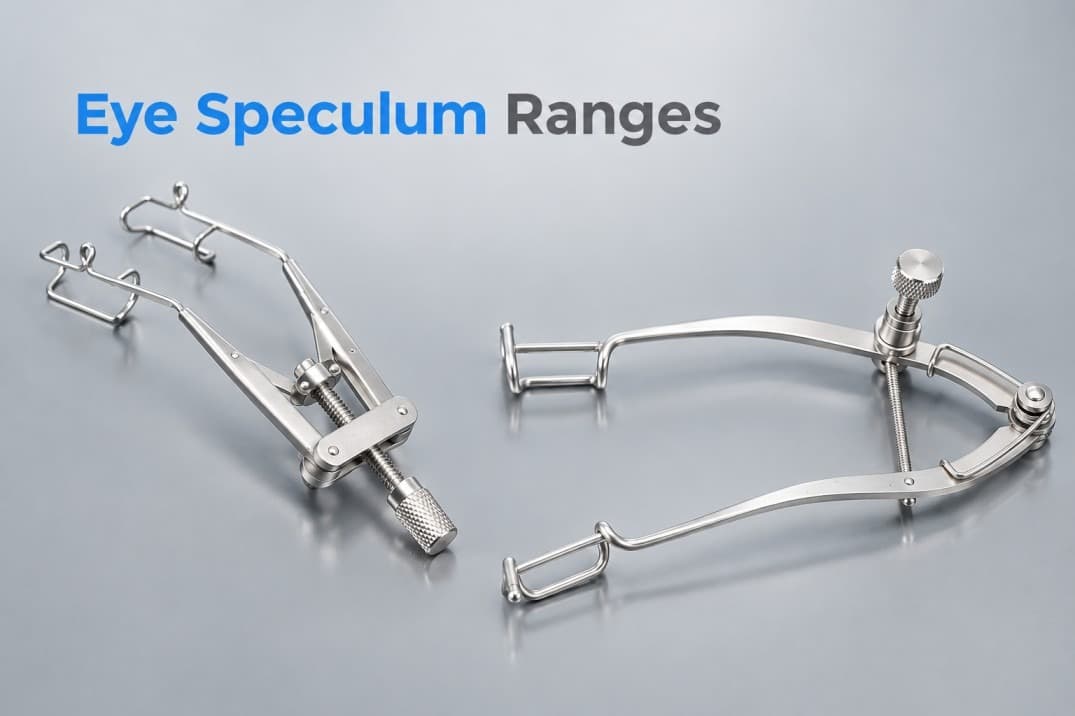
Eye speculums are important ophthalmic surgical instruments used to maintain eyelid separation and provide a stable, unobstructed surgical field during eye procedures. Different designs are available depending on the required exposure, surgical approach, patient anatomy, and surgeon preference.
For hospitals, ophthalmology clinics, surgical centres, medical distributors, and healthcare procurement teams, selecting the right eye speculum involves more than simply choosing a commonly used design. Factors such as blade configuration, adjustability, self-retaining mechanism, surgical access, material, sterilization requirements, and overall instrument quality should also be considered.
Medsprings provides a range of ophthalmic surgical instruments, including several eye speculum designs for different ophthalmic applications.
What Is an Eye Speculum?
An eye speculum is a surgical instrument designed to gently retract the upper and lower eyelids and maintain access to the ocular surface during an ophthalmic procedure.
By keeping the eyelids away from the surgical field, a speculum can help provide the surgeon with consistent access and visibility while reducing the need for continuous manual eyelid retraction.
Eye speculums are commonly used in procedures involving the cornea, anterior segment, cataract surgery, glaucoma procedures, diagnostic examinations, and other ophthalmic applications.
Different speculum designs use different mechanisms, including spring-action frames, adjustable screws, locking mechanisms, open-wire blades, and solid blades.
Why Are Eye Speculums Used in Ophthalmic Surgery?
The primary purpose of an eye speculum is to maintain adequate exposure of the eye throughout a procedure.
A suitable speculum can help with:
-
Maintaining eyelid separation
-
Providing a stable surgical field
-
Improving access to the cornea and limbus
-
Reducing the need for manual eyelid retraction
-
Allowing surgical instruments to enter the operative area more easily
-
Supporting consistent visibility during delicate procedures
-
Accommodating different patient anatomies and surgical approaches
The appropriate design depends on the procedure and the amount and direction of exposure required.
Types of Eye Speculums
There are several types of eye speculums used in ophthalmic surgery. While many designs perform the same basic function, differences in blade configuration, adjustment mechanism, frame geometry, and surgical access can make one design more suitable for a particular application.
1. Williams Eye Speculum
The Williams Eye Speculum is an adjustable ophthalmic instrument designed for controlled eyelid retraction.
Its slide-adjusting mechanism and locking screw allow the opening to be adjusted according to the required surgical exposure. The open-wire blade configuration can provide broad access while reducing obstruction around the operative field.
The Williams Eye Speculum can be considered for applications including:
-
Cataract surgery
-
Refractive procedures
-
Corneal procedures
-
Glaucoma procedures
-
Pediatric ophthalmic applications
-
Ophthalmic examinations
For hospitals and distributors, an adjustable design can be useful when the instrument needs to accommodate different palpebral opening requirements.
2. Clark Eye Speculum
The Clark Eye Speculum uses a self-retaining spring mechanism to maintain eyelid retraction without requiring an external locking screw.
Its open-wire design is intended to provide stable exposure while maintaining a relatively light instrument profile.
The Clark Eye Speculum can be used for applications such as:
-
Cataract and IOL procedures
-
Anterior segment procedures
-
Diagnostic examinations
-
Foreign body procedures
-
Intravitreal procedures
A self-retaining mechanism can be particularly useful when consistent eyelid retraction is required throughout a procedure.
3. Lieberman Eye Speculum
The Lieberman design incorporates a specialized temporal configuration and adjustable mechanism intended to provide secure eyelid retraction while maintaining access to the operative field.
Its design can be useful when the surgical approach requires careful management of the space around the eye and instruments.
For procurement teams, the Lieberman Eye Speculum can be considered as part of a broader reusable ophthalmic instrument portfolio.
4. Lancaster Eye Speculum
The Lancaster Eye Speculum is an adjustable speculum designed for controlled eyelid retraction.
Its solid curved blade configuration provides a different approach from open-wire speculum designs and can be considered where a more substantial blade profile is preferred.
The design can be useful for ophthalmic procedures where secure eyelid retraction and lash isolation are important considerations.
5. Temporal Speculum
A Temporal Speculum uses an off-axis frame configuration designed to keep the surgical access area clear.
Instead of positioning the frame directly around the main working area, the temporal configuration routes the frame toward the temporal side of the eye.
This can be useful when the surgeon requires additional access around the superior or corneal surgical area.
Potential applications include:
-
Cataract surgery
-
Clear corneal procedures
-
IOL placement
-
Toric IOL alignment
-
Glaucoma procedures
The micro-adjustable mechanism also allows the degree of eyelid retraction to be controlled according to the surgical requirement.
Open-Wire vs Solid-Blade Eye Speculums
One of the practical considerations when selecting an eye speculum is the blade configuration.
Open-Wire Speculums
Open-wire designs generally use wire loops to engage the eyelids.
Examples include:
-
Williams Eye Speculum
-
Clark Eye Speculum
-
Other wire-style ophthalmic speculums
Potential advantages include:
-
Lightweight construction
-
Reduced obstruction around the surgical field
-
Easy visualization around the blades
-
Compatibility with procedures requiring instrument access around the speculum
They may be particularly useful where minimizing interference with irrigation, aspiration, or other ophthalmic instruments is important.
Solid-Blade Speculums
Solid-blade designs use broader curved surfaces to engage and retract the eyelids.
They can provide:
-
A broader contact surface
-
Stable eyelid positioning
-
Secure retraction
-
Different exposure characteristics compared with wire designs
The choice between an open-wire and solid-blade design should depend on the procedure, surgeon preference, patient anatomy, and required surgical exposure.
Adjustable vs Self-Retaining Eye Speculums
Another important difference is how the speculum maintains its position.
Adjustable Speculums
Adjustable designs may incorporate a screw or sliding mechanism that allows the surgeon to control the degree of opening.
This can be useful when:
-
Different palpebral opening sizes are required
-
Precise control is important
-
The same instrument needs to accommodate different patients
-
The surgeon prefers manual adjustment
The Williams Eye Speculum is an example of an adjustable design.
Self-Retaining Speculums
Self-retaining designs use spring action or another mechanism to maintain eyelid retraction once positioned.
This can simplify the workflow by maintaining exposure without continuous manual adjustment.
The Clark Eye Speculum is an example of a self-retaining spring-action design.
How to Choose the Right Eye Speculum
Choosing an eye speculum should begin with the intended clinical application.
1. Consider the Surgical Procedure
Different ophthalmic procedures may require different levels and directions of exposure.
Consider whether the speculum will primarily be used for:
-
Cataract surgery
-
Corneal surgery
-
Glaucoma procedures
-
Refractive procedures
-
Intravitreal procedures
-
Pediatric examinations
-
General ophthalmic procedures
The required surgical access should guide the choice of speculum design.
2. Consider the Required Surgical Exposure
The size and geometry of the surgical field can influence which speculum is appropriate.
For example, an off-axis temporal design may be useful where keeping the main surgical corridor unobstructed is important.
An adjustable design may be preferable where the required palpebral opening varies between patients.
3. Evaluate the Blade Design
Consider whether an open-wire or solid-blade configuration better suits the intended procedure.
Open-wire designs can provide a relatively unobstructed field, while solid blades can provide broader contact with the eyelids.
The choice should also take into account patient anatomy and surgeon preference.
4. Check the Adjustment Mechanism
If an adjustable speculum is required, examine how the mechanism operates.
Important considerations include:
-
Ease of adjustment
-
Stability after adjustment
-
Smooth movement
-
Locking mechanism
-
Ease of cleaning
-
Long-term mechanical reliability
For frequently used surgical instruments, the mechanism should be practical for repeated clinical use and sterilization.
5. Consider Patient Anatomy
A speculum suitable for one patient may not necessarily provide the same level of comfort or exposure for another.
Hospitals and surgical centres may therefore benefit from maintaining multiple designs or sizes to accommodate different patient requirements.
This is particularly relevant for facilities performing both adult and pediatric ophthalmic procedures.
6. Consider Instrument Material and Construction
Reusable ophthalmic instruments should be evaluated for:
-
Surgical-grade material
-
Surface finish
-
Corrosion resistance
-
Mechanical durability
-
Blade alignment
-
Spring performance
-
Ease of sterilization
For procurement teams, these factors can influence the long-term value of an instrument beyond its initial purchase price.
7. Consider Sterilization Requirements
If the speculum is intended for repeated clinical use, its construction should be compatible with the facility's sterilization workflow.
Hospitals should consider:
-
Autoclave compatibility
-
Cleaning requirements
-
Corrosion resistance
-
Mechanism durability
-
Surface condition after repeated sterilization cycles
A reusable instrument should be selected with its complete lifecycle in mind.
Eye Speculums as Part of an Ophthalmic Surgical Instrument Set
Eye speculums are rarely used in isolation. Depending on the procedure, they form part of a larger ophthalmic surgical instrument set.
A cataract or anterior-segment procedure may require a combination of:
-
Eye speculum
-
Ophthalmic forceps
-
Ophthalmic scissors
-
Choppers
-
Nucleus manipulators
-
Cannulas
-
Needle holders
-
Ophthalmic knives
-
Other procedure-specific instruments
Medsprings provides a broader Surgical Instruments & Consumables portfolio covering reusable ophthalmic instruments, diagnostic and optical items, disposable OT consumables, and surgical accessories.
This makes it possible for hospitals, distributors, and procurement teams to evaluate related ophthalmic products within one product portfolio.
Eye Speculums and Ophthalmic Knives
Eye exposure and surgical access are closely connected with the instruments used to create and manage surgical incisions.
For example, cataract procedures may require an appropriate eye speculum alongside precision ophthalmic knives for primary and secondary incisions.
Medsprings provides a dedicated Ophthalmic Knives portfolio covering different blade configurations and surgical applications.
Related products include:
-
Clear cornea blades
-
Sideport blades
-
Crescent blades
-
Enlarger blades
Selecting compatible surgical instruments as part of a complete procedure-specific portfolio can simplify procurement for hospitals and distributors.
Eye Speculums for International Ophthalmic Procurement
For international buyers, selecting an eye speculum is only one part of the procurement process.
Hospitals, distributors, importers, and OEM partners may also need to evaluate:
-
Product specifications
-
Material and construction
-
Packaging
-
Quality documentation
-
Product availability
-
Order quantities
-
Export documentation
-
Delivery requirements
-
Long-term supply capability
-
Supplier responsiveness
Medsprings supports international healthcare procurement with a portfolio of ophthalmic surgical products for hospitals, clinics, distributors, importers, and healthcare procurement professionals.
Buyers can explore the complete Medsprings product catalogue to identify related ophthalmic instruments, equipment, surgical products, and consumables.
Sourcing Eye Speculums from India
India has an established medical manufacturing and export ecosystem, making Indian suppliers an option for healthcare distributors and procurement organizations seeking ophthalmic products.
For international buyers evaluating suppliers, the important consideration is not simply the country of manufacture. Buyers should evaluate the supplier's product range, manufacturing capabilities, quality systems, documentation, communication, and ability to support ongoing supply.
Medsprings focuses specifically on ophthalmic products and works with hospitals, clinics, distributors, importers, and OEM partners across international markets.
For buyers in Africa, Medsprings also provides dedicated regional and country-specific information, including its South Africa ophthalmic surgical products page.
Building a Complete Ophthalmic Product Portfolio
For medical distributors and importers, eye speculums can be one component of a larger ophthalmic product portfolio.
A distributor may need to source multiple complementary categories, such as:
Surgical Instruments
Including:
-
Eye speculums
-
Forceps
-
Scissors
-
Needle holders
-
Choppers
-
Nucleus manipulators
-
Cannulas
Ophthalmic Knives
Including:
-
Keratome blades
-
Sideport blades
-
Clear cornea blades
-
Crescent blades
-
MVR blades
-
Enlarger blades
Ophthalmic Viscosurgical Devices
OVDs are another important category for anterior-segment and cataract surgery.
Medsprings provides Ophthalmic Viscosurgical Devices (OVDs), including different Sodium Hyaluronate and HPMC-based formulations.
For distributors, sourcing multiple complementary product categories from a focused ophthalmic supplier can simplify procurement and portfolio development.
Related Eye Speculum Products from Medsprings
If you are evaluating eye speculums for a hospital, clinic, distributor portfolio, or ophthalmic surgical product range, explore the following Medsprings products:
-
Williams Eye Speculum — adjustable slide-locking design with open-wire blades
-
Clark Eye Speculum — self-retaining spring-action design
-
Temporal Speculum — off-axis design for unobstructed surgical access
-
Lancaster Eye Speculum — adjustable design with solid curved blades
-
Lieberman Eye Speculum — specialized temporal design with adjustable retraction
You can also explore the wider Surgical Instruments & Consumables category for complementary ophthalmic instruments.
Why Choose Medsprings for Ophthalmic Surgical Instruments?
Medsprings focuses on ophthalmic products for healthcare organizations and international distribution partners.
The portfolio supports:
-
Hospitals
-
Ophthalmology clinics
-
Surgical centres
-
Medical distributors
-
Importers
-
Healthcare procurement organizations
-
OEM partners
The product range includes ophthalmic surgical instruments, ophthalmic knives, OVDs, diagnostic products, and other ophthalmic solutions.
For organizations looking for a supplier capable of supporting multiple ophthalmic procurement requirements, a broader product portfolio can help simplify sourcing and supplier coordination.
Frequently Asked Questions About Eye Speculums
What is an eye speculum used for?
An eye speculum is used to retract the upper and lower eyelids and maintain access to the ocular surface during ophthalmic procedures. It helps provide a stable and unobstructed surgical field.
What are the different types of eye speculums?
Common designs include open-wire, solid-blade, spring-action, adjustable, temporal, and self-retaining eye speculums. The appropriate design depends on the procedure, required exposure, patient anatomy, and surgeon preference.
What is the difference between an adjustable and self-retaining eye speculum?
An adjustable eye speculum typically allows the surgeon to control the degree of eyelid opening using a screw or sliding mechanism. A self-retaining design uses a spring or similar mechanism to maintain eyelid retraction once positioned.
Which eye speculum is used for cataract surgery?
Several eye speculum designs can be used during cataract surgery. The appropriate choice depends on the surgical technique, required exposure, surgeon preference, and patient anatomy. Medsprings offers multiple designs, including Williams Eye Speculum, Clark Eye Speculum, and Temporal Speculum.
How should hospitals choose an eye speculum?
Hospitals should consider the intended procedure, surgical exposure, blade configuration, adjustment mechanism, patient anatomy, material, sterilization requirements, and long-term instrument durability.
Are eye speculums reusable?
Many ophthalmic eye speculums are designed as reusable surgical instruments. Before procurement, healthcare facilities should verify the specific product's cleaning, sterilization, and reuse instructions provided by the manufacturer.
What other ophthalmic instruments are used with eye speculums?
Depending on the procedure, eye speculums may be used alongside ophthalmic knives, forceps, scissors, choppers, nucleus manipulators, cannulas, needle holders, and other procedure-specific instruments.
Can medical distributors source eye speculums from Medsprings?
Yes. Medsprings supplies ophthalmic surgical products for hospitals, clinics, distributors, importers, and healthcare procurement professionals. Distributors can contact Medsprings to discuss product requirements, quantities, and international supply.
Explore Eye Speculums from Medsprings
Choosing an eye speculum should be based on the intended procedure, required surgical exposure, blade design, adjustment mechanism, patient requirements, and procurement considerations.
Medsprings offers multiple eye speculum designs alongside a broader portfolio of ophthalmic surgical instruments, ophthalmic knives, OVDs, and ophthalmic equipment.
If you are a hospital, ophthalmology clinic, medical distributor, importer, or procurement organization looking for eye speculums or related ophthalmic surgical products, contact Medsprings to discuss your requirements.
Explore the Medsprings Product Catalogue or Surgical Instruments & Consumables to find relevant ophthalmic products.
For product specifications, bulk requirements, distributor enquiries, or international supply, contact the Medsprings team.